

To upscale video to UHD 4K, create an output of 3840 × 2160 while preserving the source proportions. A 1920 × 1080 video reaches that size with 2x scaling. AI enhancement can improve perceived detail, but a 4K output is not the same as footage recorded natively in 4K.
This guide separates browser enhancement from desktop upscaling, explains the limits of free previews, and shows how to verify the finished file. Start from the original recording, test a short scene, and check the exact dimensions before calling an export 4K.
UHD 4K means 3840 × 2160. A scale factor alone is insufficient: 4x applied to 852 × 480 produces 3408 × 1920, not UHD 4K.
- Online enhancement is convenient for short clips, but check the actual output resolution and finished-download allowance. A free preview does not establish free 4K export.
- For desktop UniConverter, choose a documented enhancement model, preview its result, and verify the output size. Full export or a generative model can require a license or AI credits.
Keep your original file and aspect ratio. Stop increasing enhancement when faces, text, or moving edges become distorted.
In this article
- Part 1. Practical tutorial:how to upscale video to 4k online
- Part 2. Practical tutorial:how to upscale video to 4k on desktop
- Part 3. Essential factors that affect upscaling 4k video quality
- Part 4. Pro tips for achieving high-quality 4K video upscaling
- Part 5. Unlock 4k video upscaling for a range of uses and needs
- Conclusion
- FAQ
Part 1. Practical tutorial:how to upscale video to 4k online
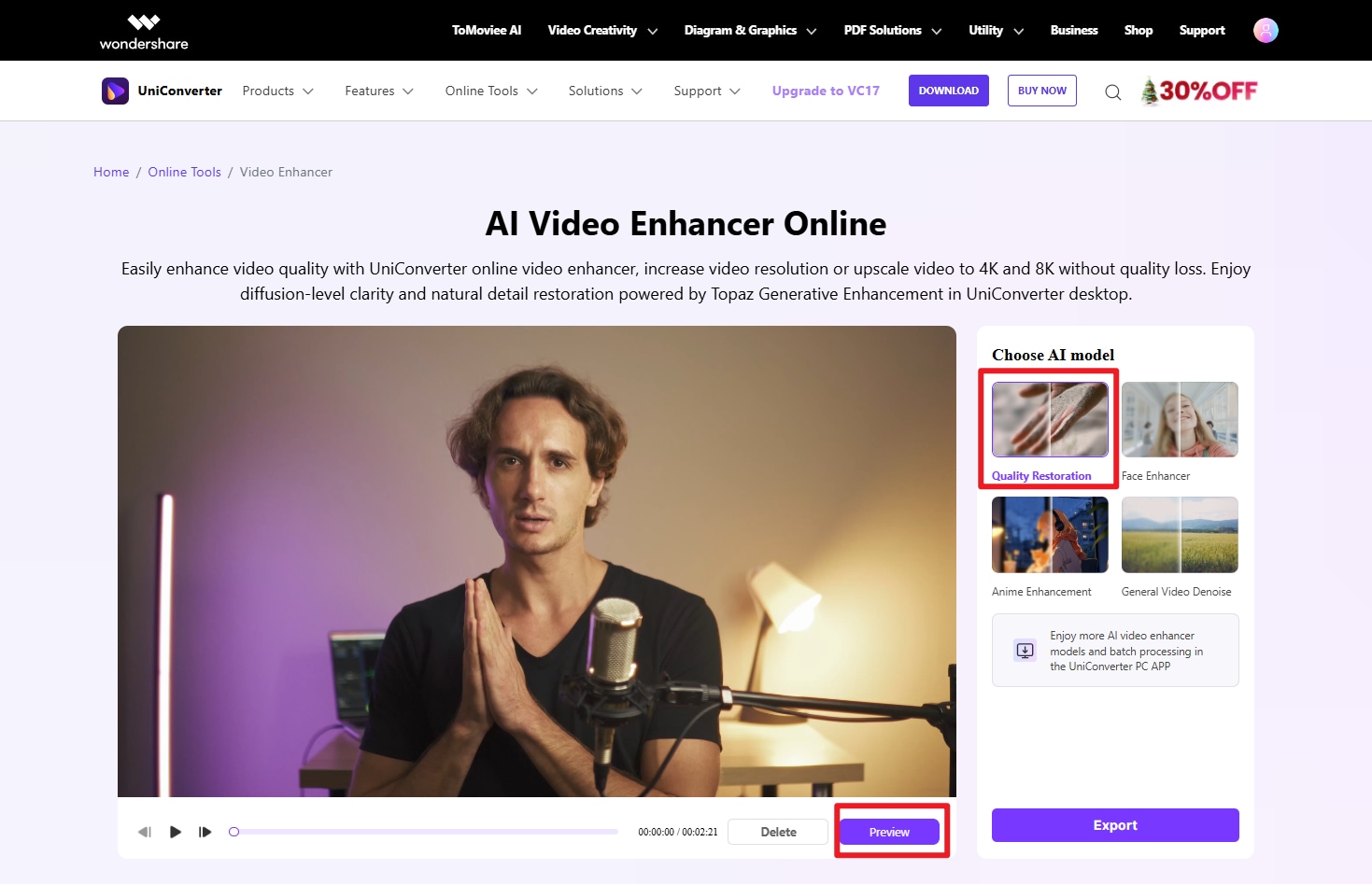
UniConverter’s online Quality Restoration tool accepts a single MP4 up to 100 MB and offers limited free use. It is useful for comparing clarity, but it should not be assumed to include the desktop model list or a fixed 4K output. If your goal is exactly 3840 × 2160, check the browser output controls first or follow the desktop 1080p-to-4K method below.
What the UniConverter Online Tool Offers
Pros:
- Runs through a browser without installing the desktop application
- Limited free use for a short quality comparison
- One MP4 up to 100 MB; use a clip you are comfortable submitting to an online service
Cons:
- Free processing and download allowances differ from desktop licensing
- Online Quality Restoration is separate from desktop Standard, Ultra, and Topaz Ultra models
- One-file online workflow; use desktop for batch enhancement
Interface illustrations show earlier versions; labels can differ. Follow the current steps and compare the controls available in your version.

Step 1. Import a supported MP4. Open the online enhancer and add one file up to 100 MB. Use the original video rather than a social-media download.

Step 2. Compare the enhanced result. Check faces, fine textures, and moving edges. Confirm the actual output dimensions and the available download allowance; do not infer 4K from a clearer preview.
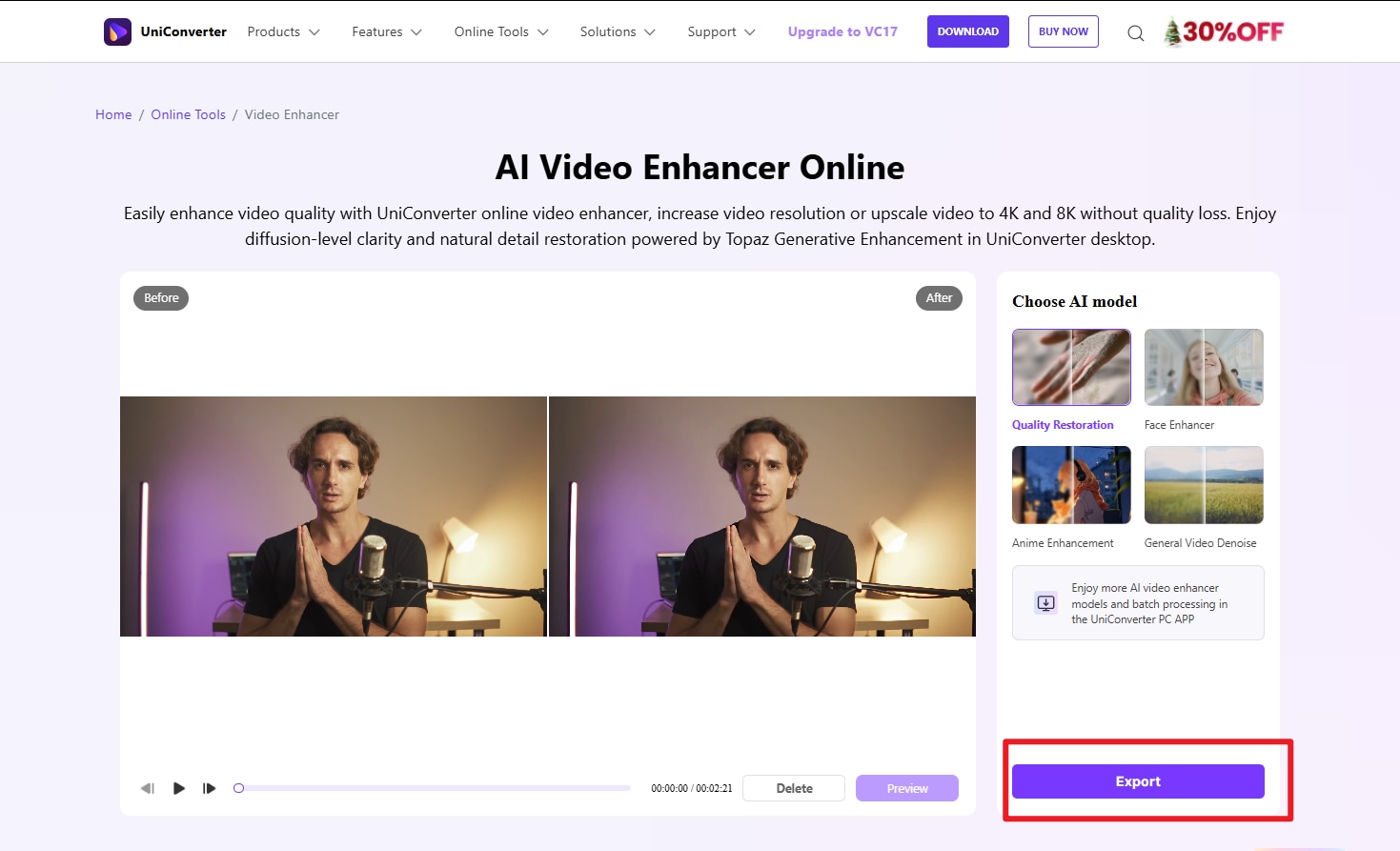
Step 3. Download and verify the file. If the output and allowance meet your needs, save the result and inspect its width and height. Use the desktop method when you require a controlled 1080p-to-4K output.
Is there a free browser option for a 4K output?
Free AI Video Upscaler offers a free browser-processing path without signup or a watermark, separate from its cloud upsell. Use a supported desktop browser, choose your file, select an available Resolution and model, then Start upscaling. Keep the tab open until it finishes, download the result, and verify that it is 3840 × 2160 if that is your target.
Browser decoding, encoding, and graphics support determine which files and settings work. HDR (10-bit) input is not supported by its browser path, and H.264 encoding can fall back to WebM on unsupported devices. If your target or codec is unavailable, use a compatible desktop tool instead of assuming every phone or browser can export free 4K.
Part 2. Practical tutorial:how to upscale video on desktop
UniConverter desktop separates spatial enhancement from other tasks. Quality Enhancement increases perceived clarity and offers output sizing; Face and Anime models target specific subjects. Frame Interpolation creates intermediate frames for smoother motion, and Video Stabilization handles shake. Neither should be described as automatically repairing lost spatial detail.
Why choose UniConverter?
Use UniConverter when you want model selection, conversion tools, and batch enhancement in one desktop application. Check the chosen model, output options, and estimated AI credits before a full job. Compare a sample on your own hardware rather than relying on a universal speed or quality claim.

Best Video Quality Enhancer
How to Upscale a 1080p Video to 4K on Windows or Mac
Step 1: Install UniConverter and open Video Enhancer.
Install the desktop application for your system. From Home, open Enhance & Clean Up → Video Enhancer. Keep the original file and work on a separate output copy.

Step 2: Import the original and choose an output.
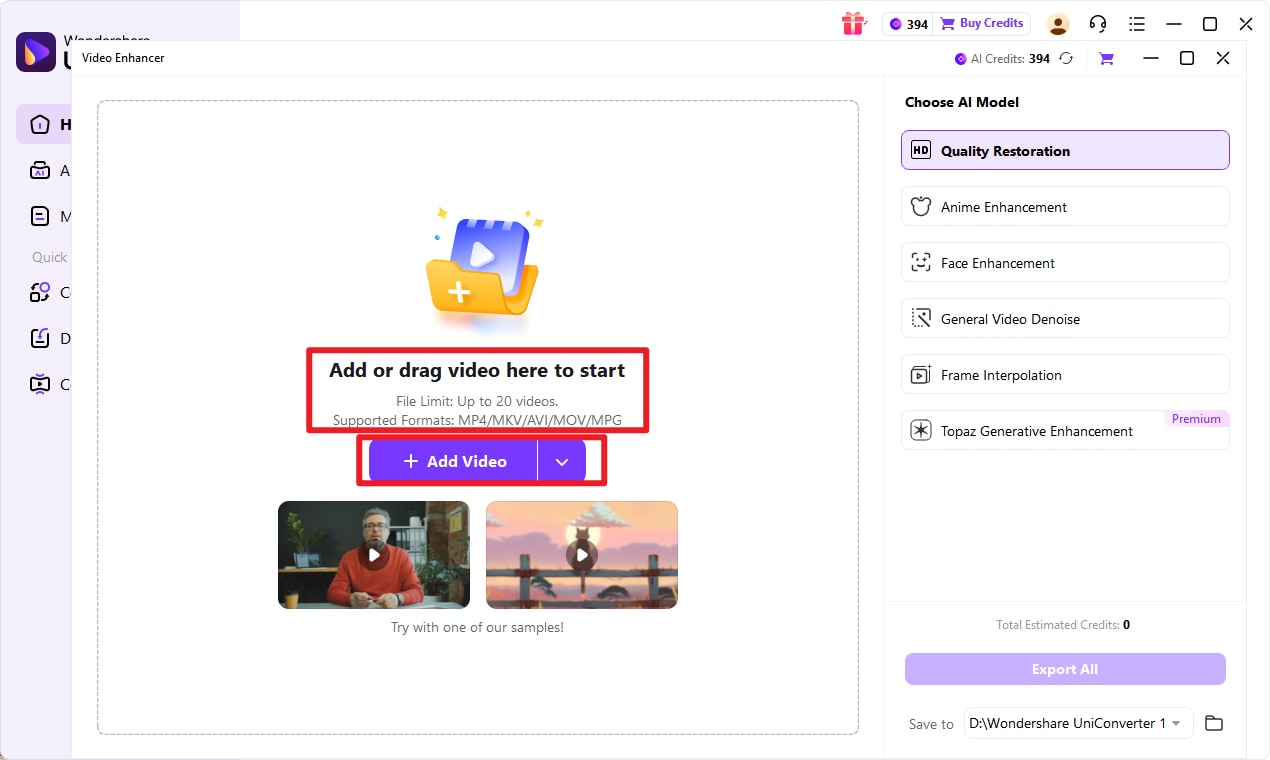
Click Add Video on Windows or Add Files on Mac. Choose Quality Enhancement → Ultra (Gen AI). For a 1920 × 1080 source, select 2x to target 3840 × 2160. The documented choices are Original, 2x, 4x, 1080P, and 2K; availability is model-specific.
Step 3: Preview and inspect detail.
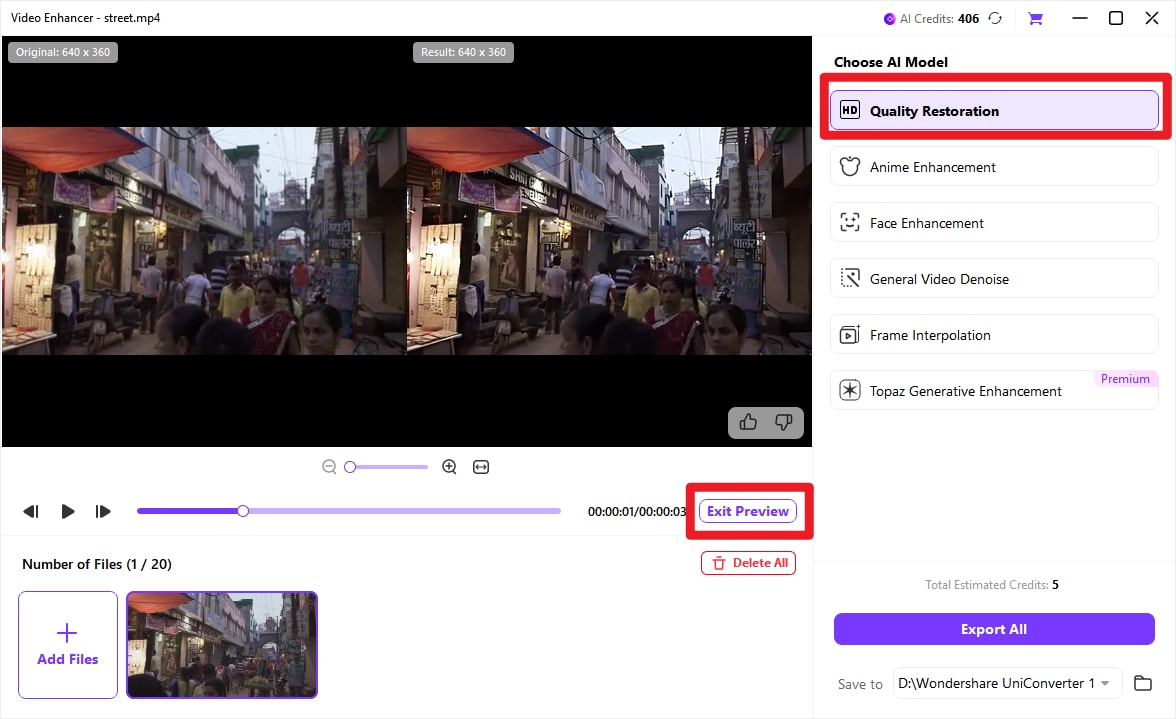
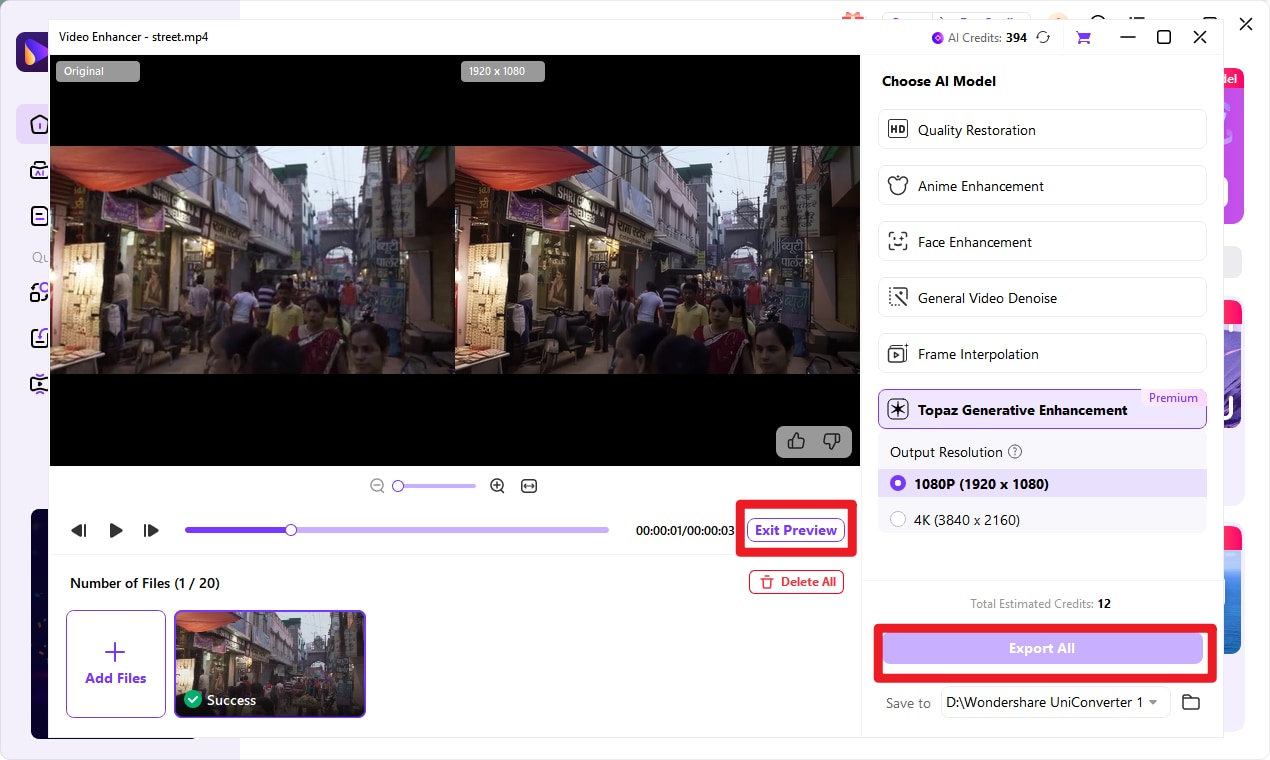
Click Preview (3 s). Compare Original and Result at the same display size, especially faces, text, noise, and moving edges. Change the model or output if the preview looks overprocessed. Preview is a sample check, not the full export.
Step 4: Export and confirm UHD 4K dimensions.
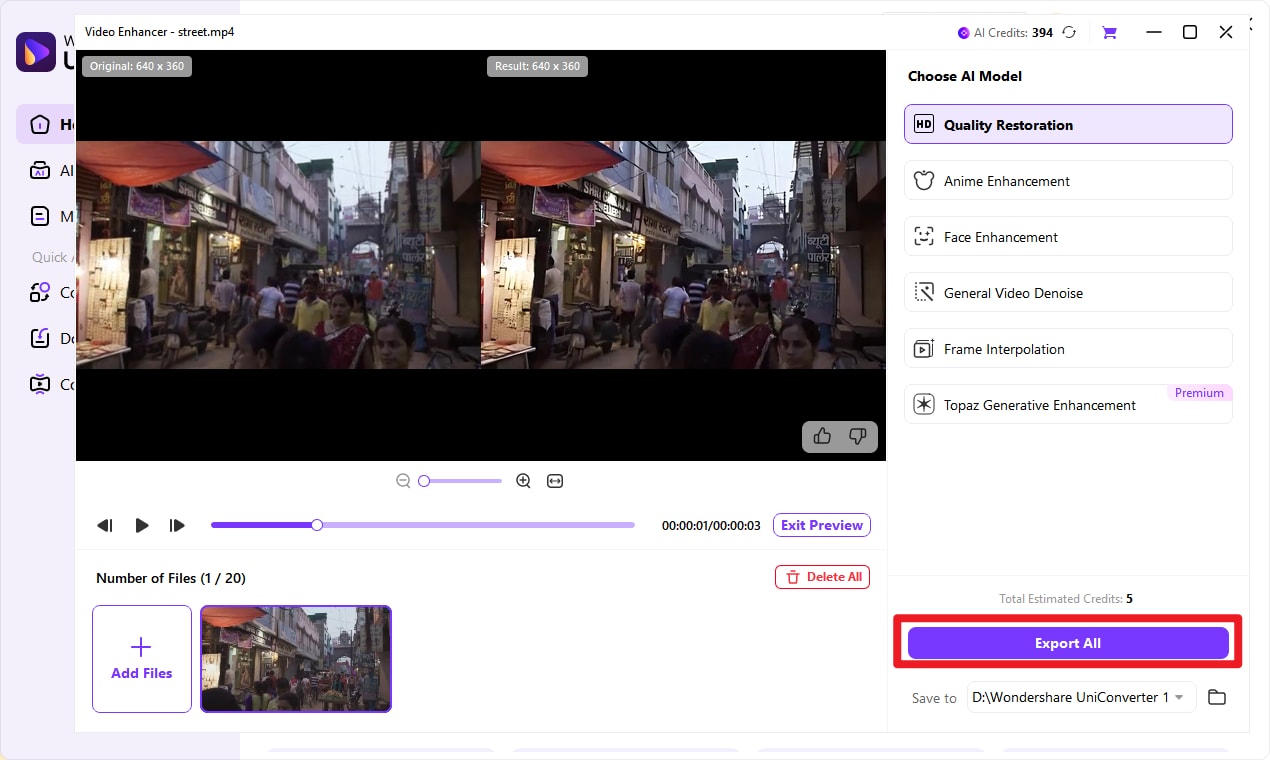
Set Save to, check the license and estimated credits, and click Enhance All & Export. After processing, inspect the finished video’s properties for 3840 × 2160, correct duration, audio, and proportions. Keep the original until the full result is acceptable.
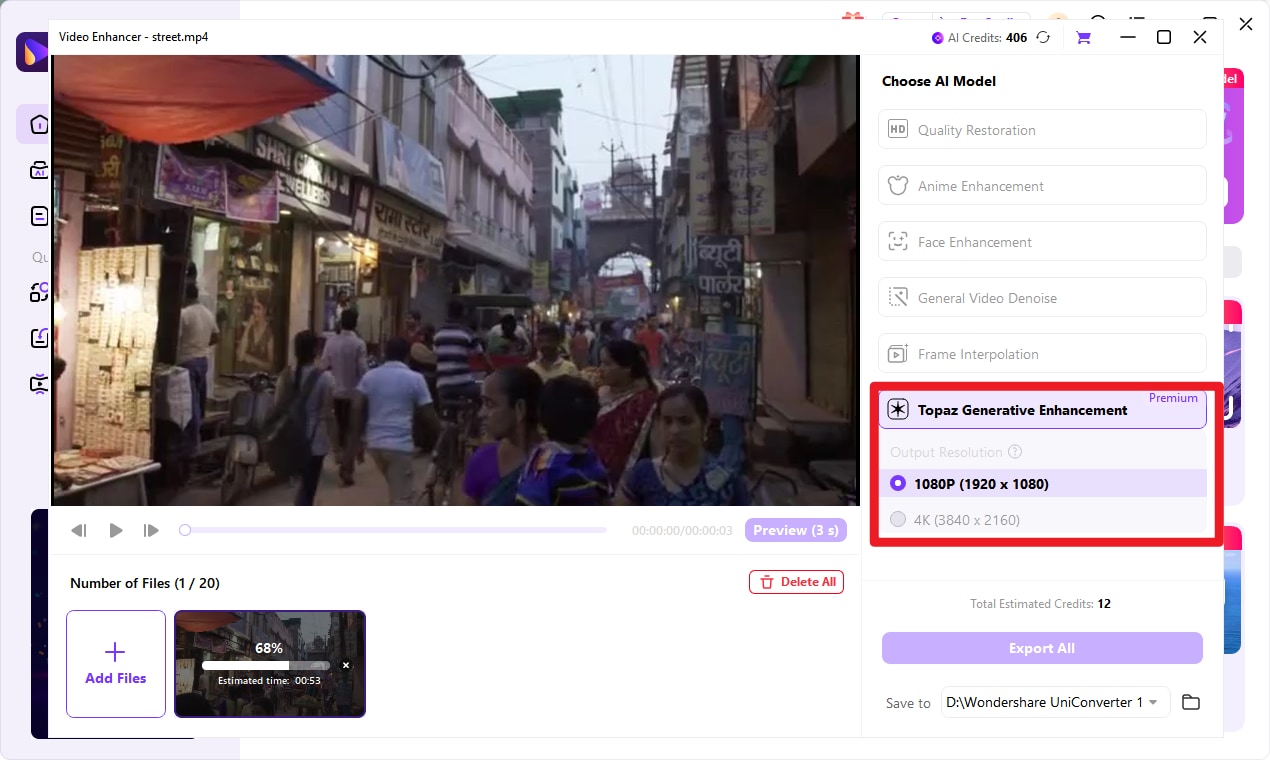
For 360p, 480p, or 720p sources: inspect the actual width and height before choosing a scale. A 1280 × 720 frame needs 3x to reach 3840 × 2160, while 640 × 360 needs 6x. Those factors are not in the documented Ultra output list. Enhance at a supported size, then use an editor or converter that explicitly accepts your final dimensions if exact UHD delivery is required. Do not relabel a 3408 × 1920 output as 4K. Generative detail should be checked against the source.
Part 3. Essential factors that affect upscaling 4k video quality
A useful 4K result needs both the right dimensions and a convincing image. Evaluate these factors before a long export:
Source video quality: The original resolution and quality of the video significantly affect the effectiveness of upscaling. Higher-quality materials produce better outcomes.
Model behavior: compare the same scene across available models. More aggressive reconstruction can sharpen an image while changing faces, text, or textures.
Bitrate and encoding: allow enough bitrate for the larger frame, but do not expect bitrate alone to recreate missing detail. More efficient codecs can change the size/quality tradeoff. Inspect the finished file instead of using a universal bitrate.
Compression artifacts: Video that has been heavily compressed can have artefacts that become more noticeable when upscaling, influencing the output.
Display quality: A higher-quality screen like 4k video upscaler can highlight improved details better. Hence, the quality of the display or device on which the upscaled video is seen is also important.
Part 4. Pro tips for achieving high-quality 4K video upscaling
Use these checks to avoid a large 4K file with little visual benefit:
Choose the best source: prefer the camera original or highest-quality transfer. Repeatedly downloaded or recompressed copies give the model less detail to work with.
Choose the correct task: AI enhancement estimates detail; conventional resizing changes dimensions. Neither guarantees native 4K quality. Pick the method that satisfies both your appearance and delivery requirements.
Control encoding: export once from the best source or enhanced master. Compare a short sample at your intended size and quality settings before rendering the entire video.
Preserve proportions: UHD 3840 × 2160 is 16:9. A 4:3 or vertical source needs a deliberate padding or cropping decision for that canvas; stretching changes the shape of subjects.
Preview and verify: watch moving sections as well as a paused frame, then inspect the exported width and height. Reject results with changed lettering, facial detail, or unstable edges.
AI Enhancement for a Higher-Resolution Viewing Copy
Part 5. Unlock 4k video upscaling for a range of uses and needs
Use upscaling when a larger viewing or delivery format serves the project. It does not prove that the source contains more authentic detail:
Family memories: save an enhanced viewing copy for a large screen and preserve the original transfer. Do not replace the archive with generated detail.
Social media: start from the original and export for the destination. A larger local file does not guarantee that the platform will retain that resolution or every detail.
Presentations: check product labels and slide text. Re-record unreadable content when enhancement invents letters rather than making the original readable.
Marketing: preview on the intended screen and prioritize consistent, believable detail. Upscaling alone does not establish an engagement or conversion improvement.
Viewing older material: preserve aspect ratio and compare noise and motion before committing a full export. Keep a separate source copy for future processing.
Conclusion
A reliable 4K workflow starts with the best source, chooses a supported enhancement setting, and verifies the finished dimensions. For a 1920 × 1080 source, 2x reaches UHD 3840 × 2160. For other sources, calculate the dimensions rather than assuming 4x means 4K. Use a short preview to judge real improvement, check full-export conditions, and keep your original.
FAQs
1. Will upscaling a video increase file size?
It often does, but size also depends on duration, codec, bitrate, frame rate, and audio. A larger frame does not impose one fixed file size. Compare a short export at your intended encoding settings; increasing bitrate does not restore missing source detail.
2. Can I convert 1080p to 4K for free online?
A free browser-processing tool such as Free AI Video Upscaler can be an option on compatible desktop hardware. Choose an available target and verify the exported 3840 × 2160 dimensions. Browser codec and graphics limits still apply. UniConverter online has limited free Quality Restoration and should not be assumed to provide unrestricted 4K export.
3. Does 4x upscaling always produce 4K?
No. Multiply the original width and height by the scale factor. For example, 852 × 480 at 4x becomes 3408 × 1920, not UHD 3840 × 2160. A 1920 × 1080 source at 2x reaches UHD 4K. Check the final dimensions instead of relying on the scale label.
4. Can every video become native-looking 4K?
No. You can increase frame dimensions, but severe blur, compression, or very low resolution limits recoverable detail. AI predicts plausible textures and can alter faces or lettering. Preview the result and keep the source; 4K dimensions alone do not prove native 4K quality.
5. Does choosing MP4 or a 4K preset add detail?
MP4 is a container, and a 4K preset sets output dimensions and encoding. Neither alone creates authentic source detail. AI enhancement estimates additional detail; conventional scaling interpolates pixels. Choose a supported method, preserve proportions, and inspect both the file properties and visible result.