
 Convert audios/videos to 1,000+ formats, including AVI, MKV, MOV, MP4, etc.

MP4 Tips & Tricks
- TRY IT FREE TRY IT FREE
- 1. Edit MP4+
- 2. Play MP4 on Different Devices +
- 3. Best MP4 Converters/Editors +
- 4. Other MP4 Tips +
All Topic
- AI Tools Tips
-
- AI Photo Enhancer Tips
- Voice Changer Tips
- AI Thumbnail Maker Tips
- AI Script Generator Tips
- Smart Summarizer
- AI Subtitle Generator Tips
- Watermark Remover
- Vocal Remover Tips
- Speech to Text Tips
- AI Video Tips
- AI Image Tips
- AI Subtitle Translator Tips
- Video Extractor Tips
- Text to Speech Tips
- AI Video Enhancer Tips
- DVD Users
- Social Media Users
- Camera Users
- Photography
- Creative Design
- Movie Users
- Travelling Fans
- Educational Users
- More Solutions
- Holidays and Commemoration
- Game Lovers
- Other Tips
[Solved] iMovie Won't Import MP4 Files
by Christine Smith • 2026-10-11 07:26:35 • Proven solutions
Does iMovie support MP4 files? --Question from Quora
iMovie is the inbuilt movie and video player available with Mac operating system. It is a highly useful software that helps in managing, editing, and transforming video files efficiently. Apart from iMovie's default extension, if you have any other video file format, you will first have to import it into the iMovie interface and then use it. However, in several scenarios, the users have encountered various problems in importing iMovie's MP4 video files. If you have encountered a similar problem that iMovie won't import MP4, then here is a quick guide on how to solve it, and then iMovie plays mp4.
(You may want to know about url to mp4 details)
iMovie won’t import MP4 because MP4 is only a container, and unsupported codecs inside the file are usually the real problem.
If an MP4 file fails to open in iMovie, the most reliable fix is to convert it into an iMovie-friendly format or preset before importing. For users who need the fastest path, this article makes format conversion the practical solution instead of repeated trial-and-error inside iMovie.
- Part 1. How to Import MP4 to iMovie on Mac and Windows
- Part 2. How to Save iMovie to MP4
- Part 3. Why Don’t Some MP4 Files Import to iMovie / iMovie Can't Support Some MP4 Files
- Part 4. Pro Tips to Ensure MP4 Support in iMovie
- Conclusion
- FAQ
Part 1. How to Import MP4 to iMovie on Mac
If you face trouble in importing an MP4 video file in iMovie, you can consider converting the MP4 format into iMovie format. When this file conversion takes place, you can easily open the newly converted video file in iMovie. For converting files from MP4 to iMovie, one of the most efficient software packages available in the market is Wondershare UniConverter (originally Wondershare Video Converter Ultimate). It contains some additional features and supports many file formats. When you download Wondershare UniConverter, you have complete video file management software from which you cannot only transform videos but also download videos from the Internet.
Wondershare UniConverter
-
Convert audio/video format to other 1000+ video formats like MP4, MOV, AVI, etc.
-
30X faster conversion speed than any conventional converters
-
Edit the video files with trimming, cropping, cutting, merging, adding subtitles, etc.
-
Burn videos to DVD with customized free DVD menu templates
-
Download or record videos from 10,000+ video sharing sites
-
Industry-leading APEXTRANS technology converts videos with zero quality loss or video compression
-
Versatile toolbox combines video metadata editor, GIF maker, video compressor, and screen recorder
If you want to follow this solution, then here are steps:
Step 1 Install Wondershare UniConverter for Mac.
No matter whether you are using Mac or Windows operating system, you can easily download Wondershare UniConverter to your computer from the website. The software comes in both trial and purchase versions, so the users are given the complete freedom to try the software first before they pay. Once you have downloaded the software from the Internet, a user-friendly wizard will guide you through the entire installation process, and you can also choose your custom settings in between.
Step 2 Launch the software and import your MP4 file.
Once you have downloaded the software, the next step is to launch it. Wondershare UniConverter has an extremely friendly user interface so you can easily navigate through the software without any guidelines. For converting your MP4 file into an iMovie compatible video file, import the desired MP4 video file. You can open your MP4 file by either dragging it into the interface or clicking on the Add Files button. Clicking on the Add Files button will take you to the File Explorer to choose the desired file.
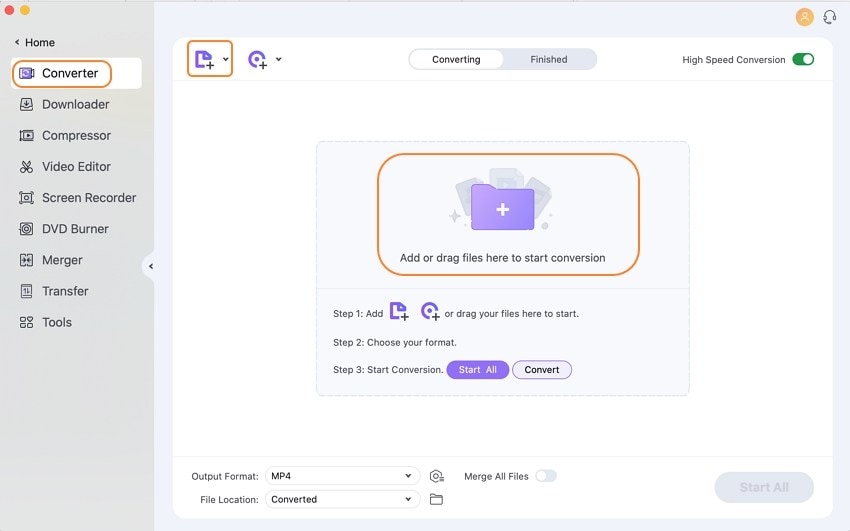
Step 3 Select the output format as iMovie.
Click the drop-down icon beside Output Format and select Editing > iMovie and the detailed preset. And then, click the Create tab to confirm the changes for the video.
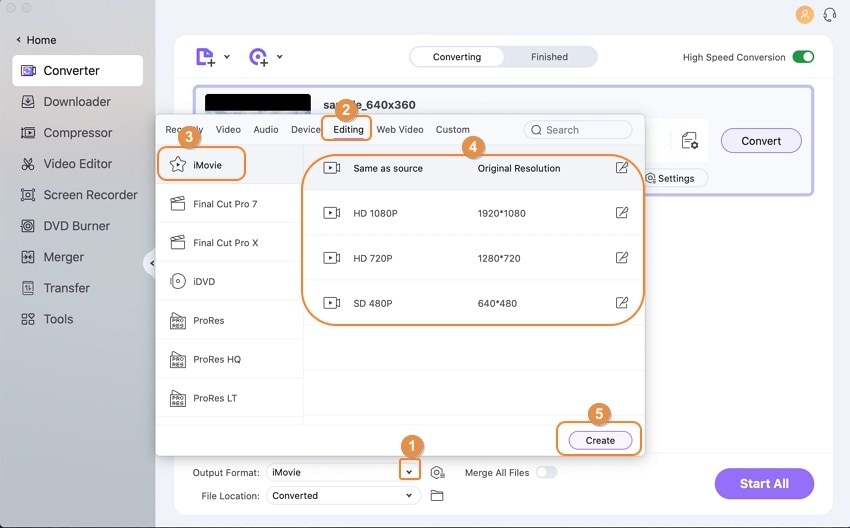
Step 4 Convert your MP4 file to iMovie.
Once you have selected the target format, you can press the Start All button to start the actual conversion. The MP4 file will take only a few seconds to perform the conversion. You can find the completed file in the Finished tab.
Part 2. How to Save iMovie to MP4
people well accept iMovie file format, but there is a huge possibility that you would like the iMovie file to be played in your mobile device. All the mobile devices do not support iMovie file format, which is why you’ll need to convert it into an MP4 file format. It is possible through iMovie itself, and you don’t have to download any additional software packages for it.
To save iMovie to MP4, please follow the steps below:
Step 1 Launch iMovie software and use the export option.
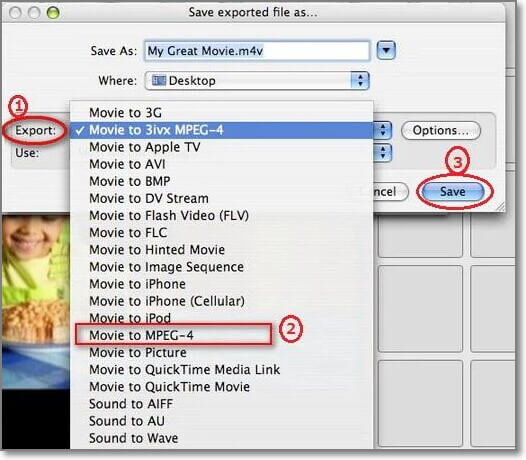
The very first is to launch the iMovie software. Choose the Share option from the menu bar and then select the Export Using QuickTime option.
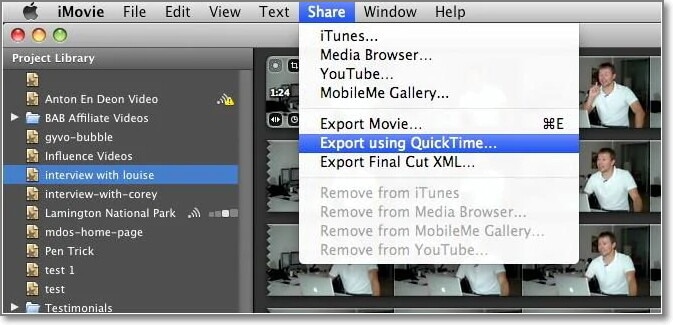
Step 2 Choose Movie to MPEG-4 saving.
Once you have clicked on the Export Using QuickTime option from the Share menu, a popup window will appear. This window contains some options like name, location of files, etc. Click on the export option available on this window, and you will land upon an array of options like Movie to 3G, Movie to MPEG-4, etc. Choose the Movie to MPEG-4 option from this popup and click on the Save button to save your iMovie file as MP4.

Easy to Use MP4 to iMovie Converter

Part 3. Why Don’t Some MP4 Files Import to iMovie / iMovie Can't Support Some MP4 Files
MP4 video files are becoming highly popular among people due to its compatibility with most mobile devices. However, if you are using iMovie and MP4 together, you might encounter some strange behavior. One such behavior is that iMovie just refuses to accept your MP4 video file. Although the iMovie software generally takes MP4 files, sometimes it refuses to, which leaves the user pondering the reason could be? If you are also trapped in one such dilemma, then here are a few cases that will throw some light on what could be wrong if your iMovie software is not importing MP4 files now!
Case 1:
To be quite specific, iMovie imports MP4 files that are encoded using MPEG4/AAC or /AAC data. If some other codec is used to encode your MP4 video file, then codec difference might be one of the major issues why your iMovie is not importing that MP4 file. One of the most recommended solutions for this problem is to convert your MP4 file format into an iMovie compatible file format.
Case 2:
By default, iMovie contains all the codecs usually used by the MP4 files. However, there are MP4 files that contain different codecs for their audio and subtitle streaming. If these codecs are not included in the iMovie support codecs group, then there is a huge possibility that the particular MP4 will not be imported in iMovie.
Easy to Use MP4 to iMovie Converter
Part 4. Pro Tips to Ensure MP4 Support in iMovie
1. Confirm Codec Compatibility
Only MP4 videos encoded with H.264 (video) and AAC (audio) are reliably accepted by iMovie.Before importing, check file properties: right-click the file, select “Get Info” (Mac), and look for the codec details. If you see codecs like DivX, VP9, or AC3, re-encode to H.264/AAC.
2. Use Reliable Converters
Convert problematic MP4s with dedicated video converters (Wondershare UniConverter, Movavi, Cisdem Video Converter). These offer presets specifically for iMovie that guarantee format, codec, and container compatibility.
Avoid free or online converters that don’t specify codec output; they may default to unsupported codecs.
3. Check Audio Tracks and Subtitles
MP4 files with multiple audio streams or embedded subtitles may fail to import. Remove extra tracks or use converter settings to limit output to a single audio stream and disable subtitles.
4. File Integrity and Resolution
Corrupted or partially downloaded MP4 files will not import to iMovie. Always verify the integrity and playability of your media before conversion or edit.
Extremely high resolutions (e.g., 8K) or uncommon framerates may cause issues. Downscale to standard resolutions like 1080p or 720p if problems persist.
5. Batch Conversion for Multiple Files
When working on projects with many MP4 files, batch convert all files with the same iMovie preset to avoid mismatches and wasted time importing unsupported formats.
6. Keep Software Updated
iMovie and macOS updates improve codec support. Running the latest versions can reduce compatibility issues with newer MP4 formats, such as HEVC/H.265.
7. Test Before You Edit
After conversion, always test-import one file into iMovie before working on your entire project to confirm compatibility and settings.
FAQ
-
1. Why doesn't iMovie import some MP4 files?
MP4 files created with codecs other than H.264 video and AAC audio (e.g., DivX, VP9, AC3 audio) won’t be recognized by iMovie. MP4 files may contain unusual metadata, multi-track audio, or subtitles that iMovie cannot process unless converted with supported settings. -
2. How do I make MP4 files compatible with iMovie?
Convert MP4 files using software like Wondershare UniConverter; select "Editing > iMovie" in the format selector to output a compatible file for import. Always use H.264 for video and AAC for audio tracks within the MP4 container. -
3. Can I edit MP4s in iMovie after conversion?
Yes, converting to the iMovie preset ensures smooth editing, and you can further enhance or adjust your project in iMovie as normal. -
4. How do I export iMovie projects as MP4?
Within iMovie, use “Share” > “Export Using QuickTime,” then choose “Movie to MPEG-4” in the dialog to save the finished video as an MP4 file. -
5. What's the fastest way to fix MP4 import issues in iMovie?
Download and use a trusted converter such as UniConverter; select the dedicated iMovie output profile and batch-process your videos. For persistent issues, check file properties to confirm codec, resolution, and audio format match supported iMovie settings.
Related Articles You May Want to Know:

Your complete video toolbox
Other popular Articles From Wondershare


Christine Smith
chief Editor