
If you're searching for a reliable Topaz Video AI review, you likely want to know one thing: does it truly improve video quality, or is it just another AI tool with bold claims? Topaz Video AI is widely used for upscaling low-resolution footage, reducing noise, and restoring older clips, but performance depends heavily on hardware and source quality.
In this Topaz Video Enhance AI review, you’ll get a clear, objective breakdown of its real capabilities, limitations, pricing, and whether it’s worth using in 2026.
Best Alternative to Topaz Video AI
In this article
- Part 1: What is Topaz Video AI?
- Part 2: Key Features of Topaz Video AI
- Part 3: Topaz Video AI Performance Test
- Part 4: Topaz Video AI Pricing and Free Trial
- Part 5: Pros and Cons of Topaz Video AI
- Part 6: Topaz Video AI vs. Competitors: Which One Should You Choose?
- Common User Questions about Topaz Video AI
- Conclusion: Is Topaz Video AI Worth It?
Part 1: What is Topaz Video AI?
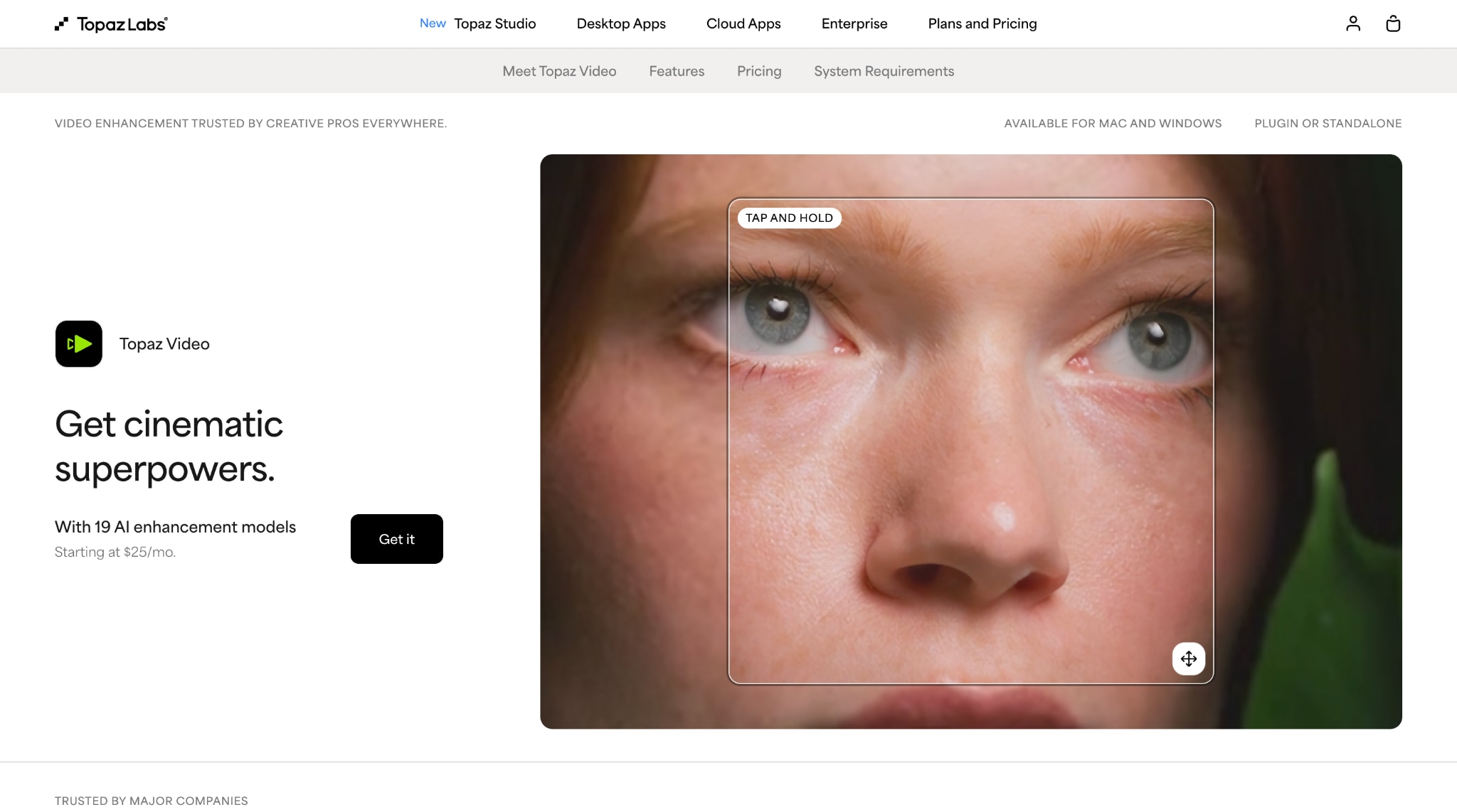
Topaz Video AI is a desktop application from Topaz Labs that improves video quality using artificial intelligence. If you have footage that looks blurry, noisy, shaky, or low-resolution, this software is built to fix those issues. Instead of applying simple filters, it studies each frame and rebuilds detail based on trained AI models.
Many people call it Topaz Video Enhance AI because its main goal is straightforward. It enhances your video, making it clearer and more refined, without requiring complex manual adjustments.
What Does Topaz Video Enhance AI Do?
Topaz focuses on four core improvements. First, it handles resolution through Topaz upscale, which increases video size, such as converting 1080p to 4K, while preserving natural detail. Upscaling means raising the resolution and intelligently adding missing detail so the image does not look stretched.
Topaz Video Enhance AI also removes grain through denoising, smooths shaky clips with stabilization, and improves motion using frame interpolation. Frame interpolation adds extra frames between existing frames to increase the frame rate and create smoother playback.
Who Should Use Topaz Video AI?
Topaz Video AI is useful for YouTubers, content creators, video editors, film restoration professionals, and even hobbyists who want to improve old family videos or low-quality clips.
Part 2: Key Features of Topaz Video AI
In this Topaz Video AI review, the focus is on how the software improves real footage by leveraging AI models that analyze motion, texture, and edges across frames to produce clearer, smoother, and higher-resolution results.
AI Video Upscaling (1080p to 4K and 8K)
Topaz Video Upscale is one of its most talked-about features. When increasing resolution from 1080p to 4K or even 8K, Topaz Video AI does more than stretch pixels. It analyzes surrounding frames to understand edges, faces, and fine textures, then naturally rebuilds missing detail.
With Topaz AI Upscale, details such as hair strands, fabric patterns, and background textures often appear clearer compared to traditional scaling tools. Results vary depending on source quality, but well-shot HD footage tends to upscale more cleanly than heavily compressed clips.
Noise Reduction and Video Enhancement Tools
Grain and digital noise are common in low-light footage or older recordings. Topaz video enhance models are designed to remove noise without completely smoothing the image. Instead of blurring everything, the AI separates actual detail from unwanted grain.
Topaz AI video enhancement tools are especially helpful for dark indoor scenes, event recordings, and archival footage. Faces retain their shape, and textures remain visible, preventing the waxy effect that some noise-reduction tools create.
Frame Interpolation for Smoother Motion
Frame interpolation increases the frame rate by generating new frames between existing ones. For example, 24 fps footage can be converted to 60 fps for smoother motion. The software estimates how objects move from one frame to the next and creates intermediate frames that follow that motion path.
This works well for sports clips, action scenes, and slow-motion sequences where smoother playback improves clarity. Fast or complex motion can sometimes create minor artifacts, but results are generally strong when the original footage is stable.
Video Stabilization and Motion Deblur
Shaky footage can reduce overall quality, especially in handheld recordings. The stabilization tool reduces unwanted camera movement while keeping the subject centered. Motion deblur attempts to recover clarity in fast-moving scenes where details appear smeared.
Topaz Video AI is practical for travel videos, documentary projects, and footage that cannot be reshot. Improvements depend on how severe the shake or blur is in the original clip.
Batch Processing and Workflow Efficiency
Topaz Video AI supports batch processing, so you can queue multiple clips and process them together instead of exporting files one by one. Topaz AI is helpful when enhancing long video projects or restoring large video archives.
Rendering speed depends on your system’s GPU because Topaz Video AI uses hardware acceleration to run its AI models. A dedicated graphics card improves processing time, especially for 4K upscaling and frame interpolation.
Part 3: Topaz Video AI Performance Test
Upscaling Test Results
When upscaling 1080p to 4K, DVD-quality SD discs, or compressed web clips, Topaz Video AI generally produces noticeably sharper detail, smoother diagonal lines, and fewer jagged edges. The improvement is especially visible with 480p and 720p sources, where edges look cleaner, and textures appear more defined.
However, with very soft VHS footage or heavily compressed videos, the Topaz Video AI can sometimes create artificial-looking textures or slight oversmoothing instead of restoring genuine detail. The results depend heavily on the quality of the source.
Processing Speed and Hardware Requirements
Upscaling a 30-second 720p or 1080p clip to 4K can take approximately 10–15 minutes on a system equipped with an RTX 4070-level GPU. On mid-range graphics cards, rendering full-length movies can take several hours.
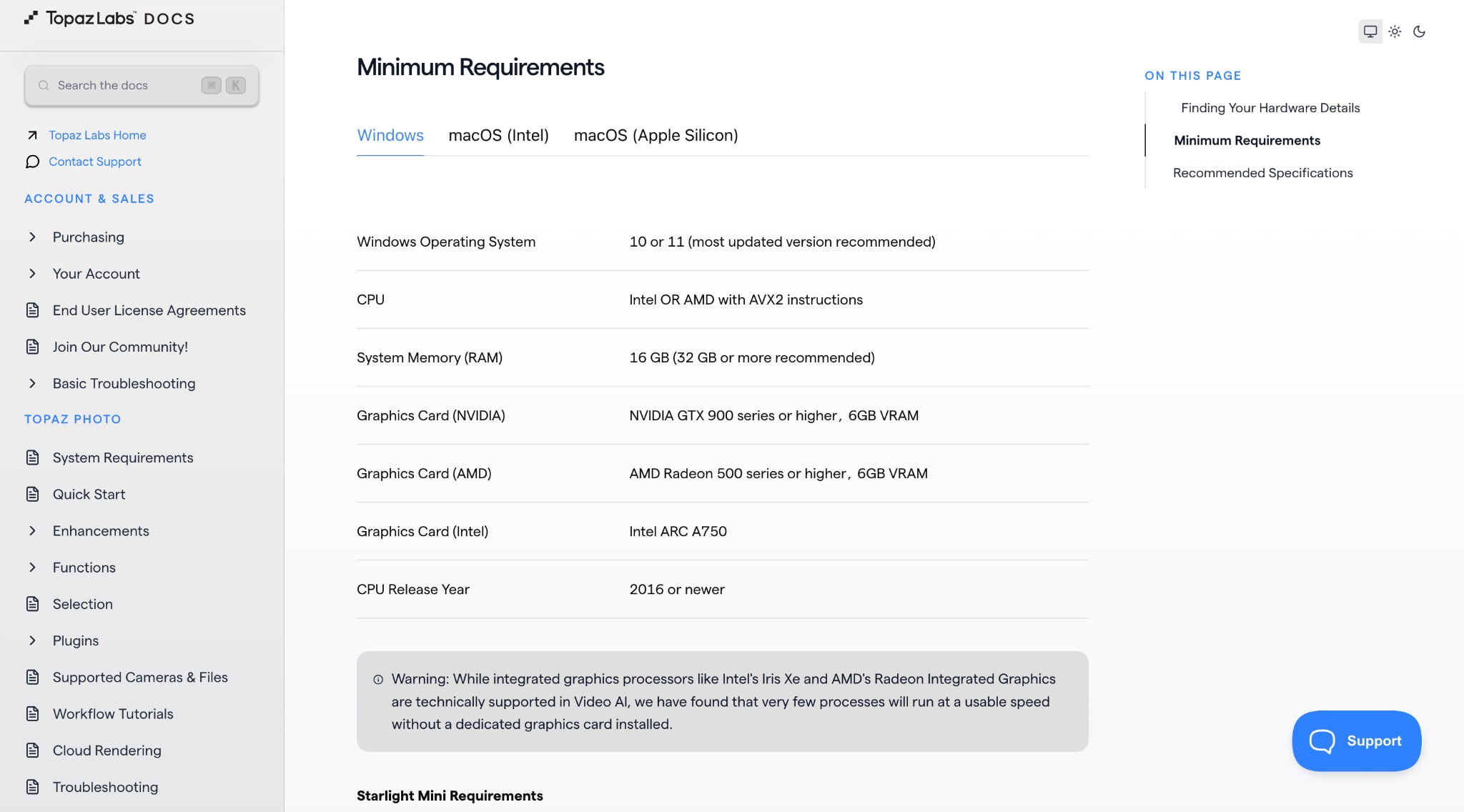
The official requirements recommend a modern multi-core CPU, at least 16 GB of RAM, and a dedicated DirectX 12-compatible GPU with 6–8 GB of VRAM. Performance scales significantly with GPU power, making hardware the key factor in processing speed.
Output Quality vs. File Size
To preserve the additional detail created during upscaling, exporting 4K video at 40–80 Mbps is common. This often results in file sizes roughly twice the source.
Reducing the bitrate lowers file size but can reintroduce banding, compression artifacts, or softness that diminish the visual improvements. As a result, higher storage requirements are the primary trade-off for maintaining clean, artifact-resistant output.
Part 4: Topaz Video AI Pricing and Free Trial
Topaz Video AI Pricing Plans
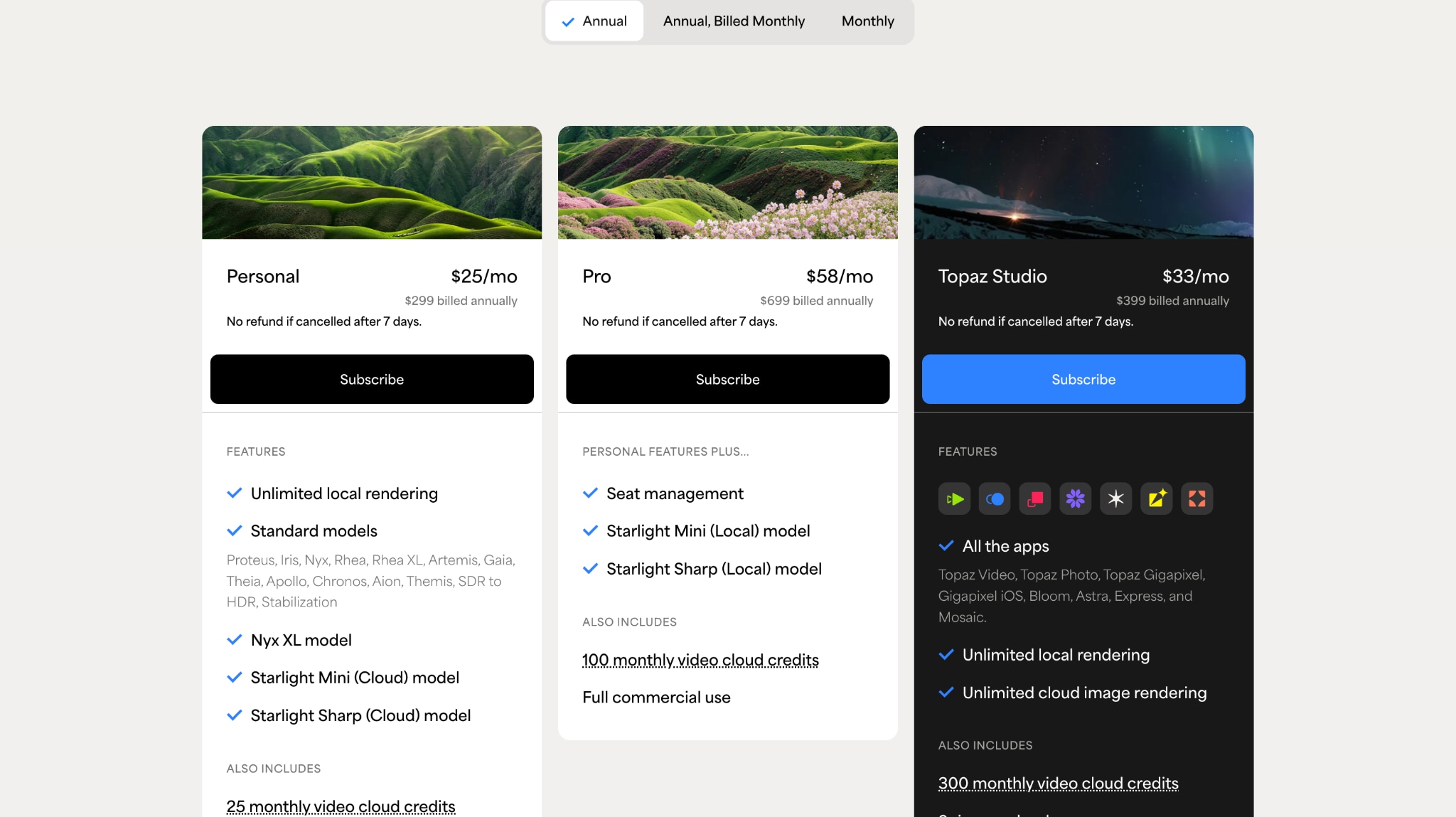
Topaz Video AI offers flexible pricing plans depending on your needs. You can purchase Topaz Video AI as a standalone tool or as part of Topaz Studio, which includes all Topaz apps. Topaz Video AI is available with annual and monthly subscriptions.
| Plan | Billed Annually | Annual Plan (Billed Monthly) | Monthly Plan | Key Features | Cloud Credits | License/Use |
| Personal | $25/mo ($299/year) | $33/mo | $59/mo | Unlimited local rendering, Standard AI models (Proteus, Iris, Nyx, Rhea, etc.) | 25 per month | Personal & small business (<$1M revenue) |
| Pro | $58/mo ($699/year) | $67/mo | - | - | - | - |
| Topaz Studio | $33/mo ($399/year) | $37/mo | $69/mo | Includes all Topaz apps, Unlimited local & cloud rendering, Cloud-only access to advanced models | 300 per month | Personal & small business (<$1M revenue) |
These plans include ongoing upgrades, ensuring you always have access to the latest Topaz Video AI models and enhancements.
Is There a Free Trial?
Topaz Video AI does not offer a standard free trial before purchase. To try the Topaz Video AI for 7 days:
- You must purchase a plan (Personal, Pro, or Topaz Studio).
- After purchase, you can download and install the software.
- Limited cloud credits are included each month for cloud rendering and testing advanced AI models.
- Exports are fully functional with purchased plans; no feature is hidden once access is granted.
This means that, unlike other tools, you cannot test Topaz Video AI for free before paying. The “trial” is effectively a fully-featured starter period post-purchase, letting you explore capabilities while using your allocated cloud credits.
Important: If you cancel after 7 days from the purchase date, there is no pro-rated refund.
How to Download Topaz Video AI
To download Topaz Video AI, follow the steps below:
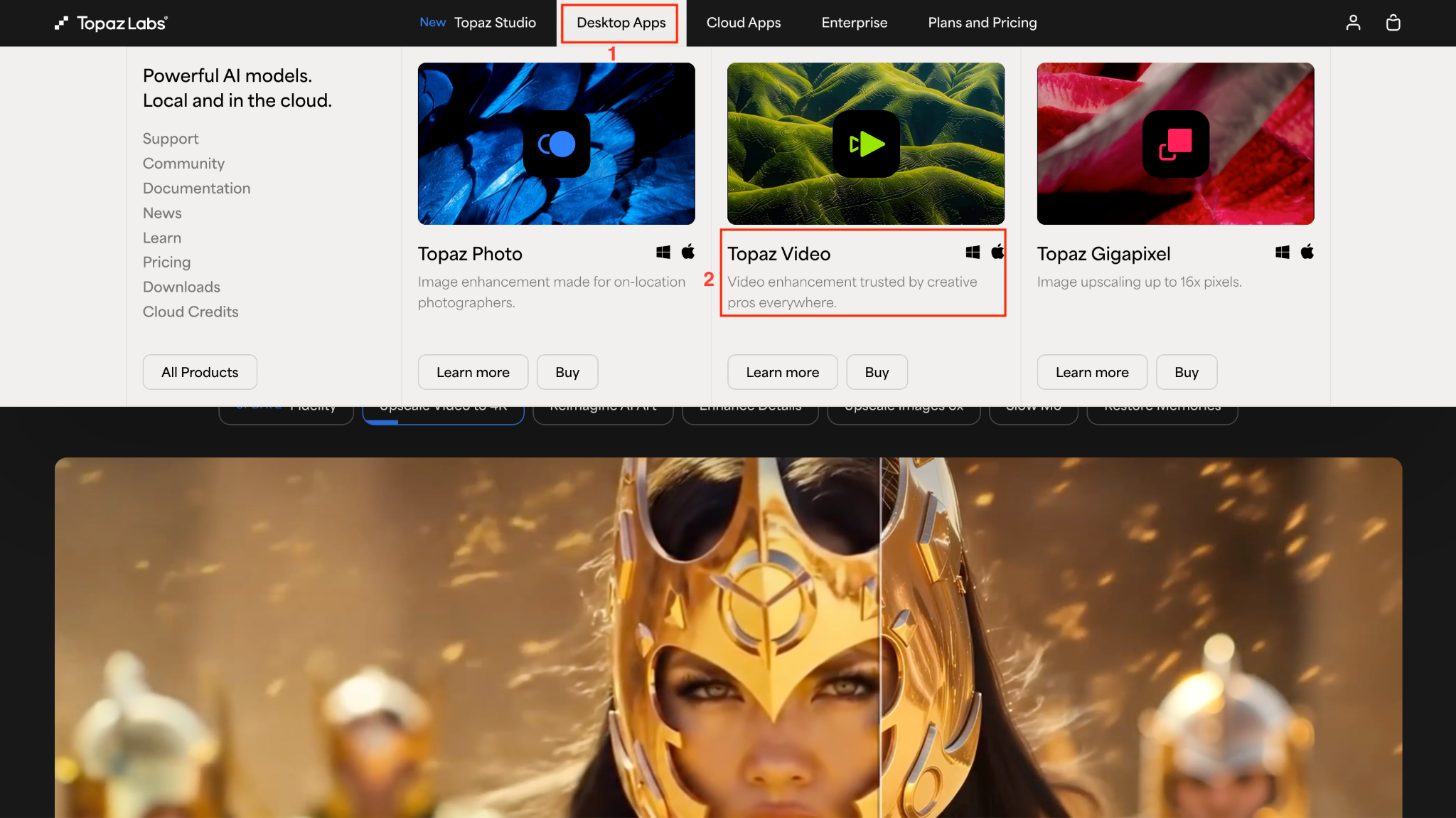
Step 1: Visit the Topaz Labs official website, navigate to Desktop Apps, and choose Topaz Video.
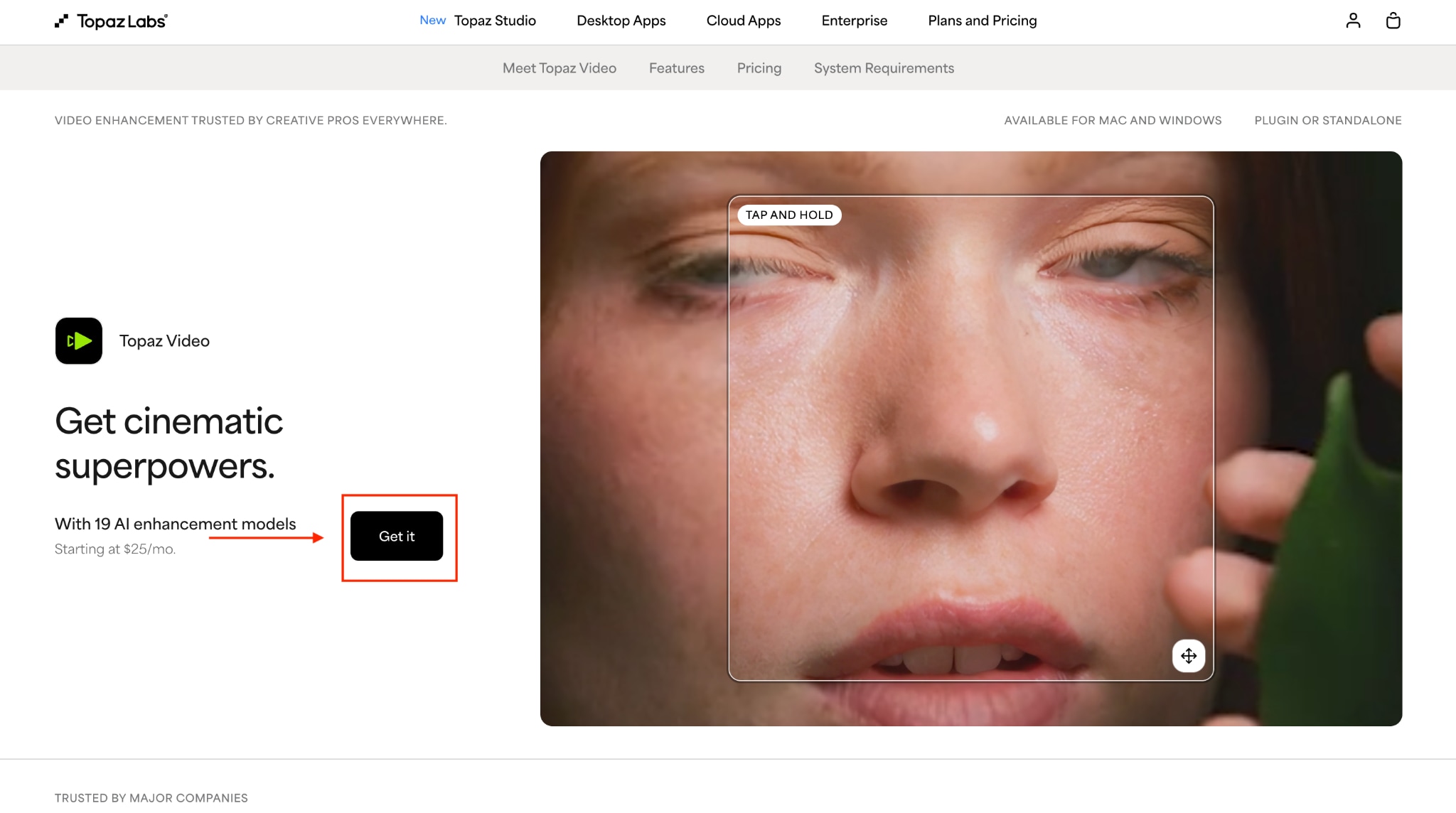
Step 2: Click the “Get it” button, and it will redirect you to pricing.
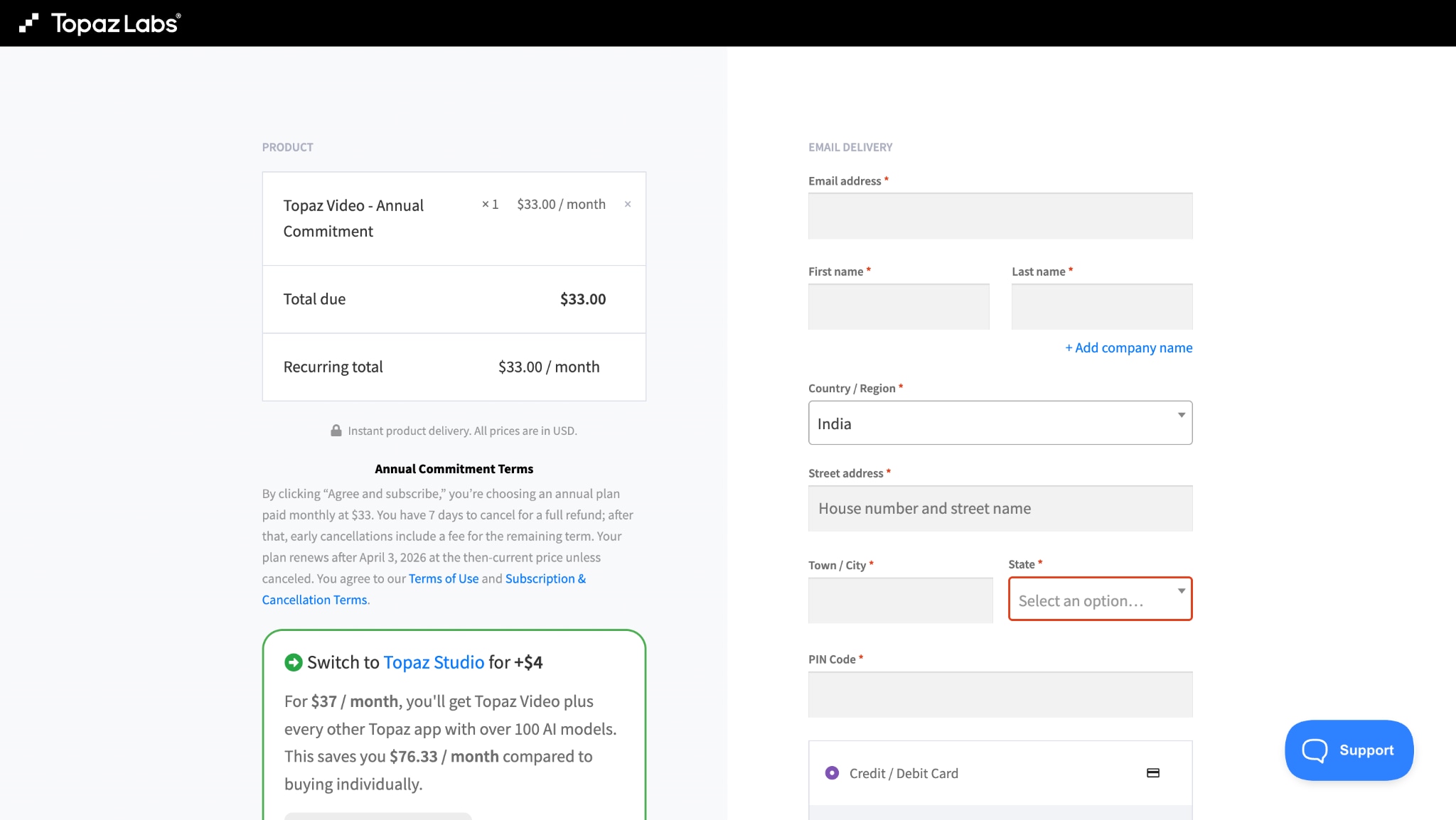
Step 4: Choose the plan and complete payment details.
Step 5: Install the software and log in with your Topaz account to start enhancing videos.
Part 5: Pros and Cons of Topaz Video AI
Topaz Video AI is a great choice for its strong AI features, but it demands good hardware and can take time to learn. You get great results with the right setup, though it is not cheap or quick on weaker machines.
Pros of Topaz Video AI
- Provides high-quality upscaling that restores details such as faces, textures, and film grain, even in old or low-resolution footage.
- Offers a wide range of AI models, including Proteus, Iris, Nyx, Rhea, Artemis, Gaia, Apollo, Chronos, Aion, and Themis, as well as tools for denoising, stabilization, frame interpolation, and SDR-to-HDR conversion.
- Regularly updated with new AI models and bug fixes, ensuring improved performance and features.
- Many users say Topaz Video AI makes old family and archive videos look watchable again, which helps you rescue footage you thought was unusable.
- Allows enhancement and upscaling with a few clicks, while also offering advanced options for greater control.
- Combines multiple improvements, noise removal, sharpening, face recovery, and resolution enhancement in a single tool, saving the need to use multiple programs.
- User-friendly interface that delivers good results without requiring professional editing skills.
- Supports batch processing, enabling multiple clips to be queued for automatic processing.
Cons of Topaz Video AI
- Requires a powerful GPU, such as an NVIDIA GTX 900 series with 6GB VRAM, while some models require 8GB or more. Integrated graphics and older cards struggle to run heavier models.
- Rendering times are long on typical hardware; one minute of 1080p to 4K can take around 15 minutes on an RTX 3060, and longer clips may take hours on weaker GPUs.
- Lacks full editing tools like timelines, titles, or transitions, so a separate editor is still needed for complete video projects.
- High subscription cost, ranging from $17 to $67 per month, which can feel expensive for casual users.
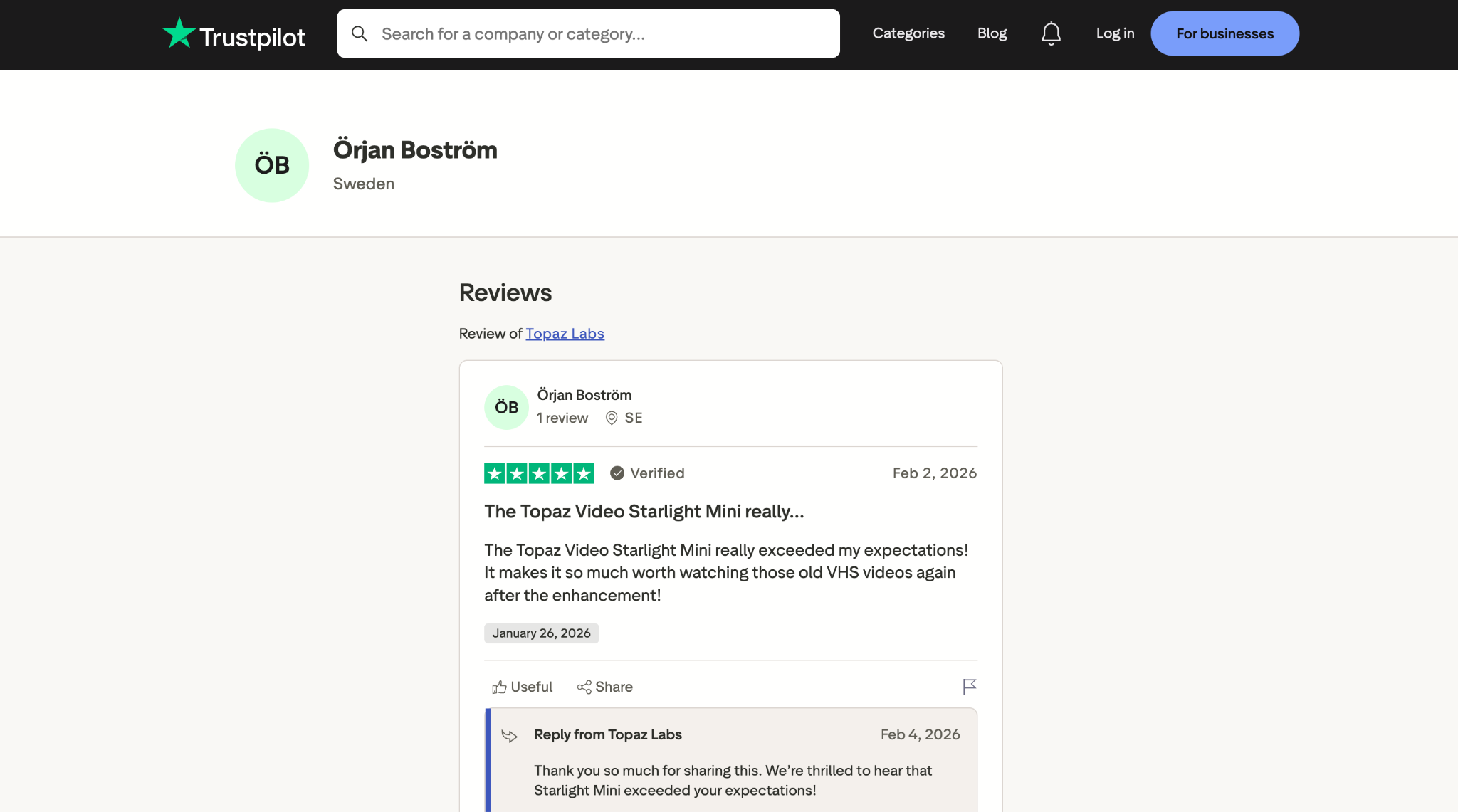
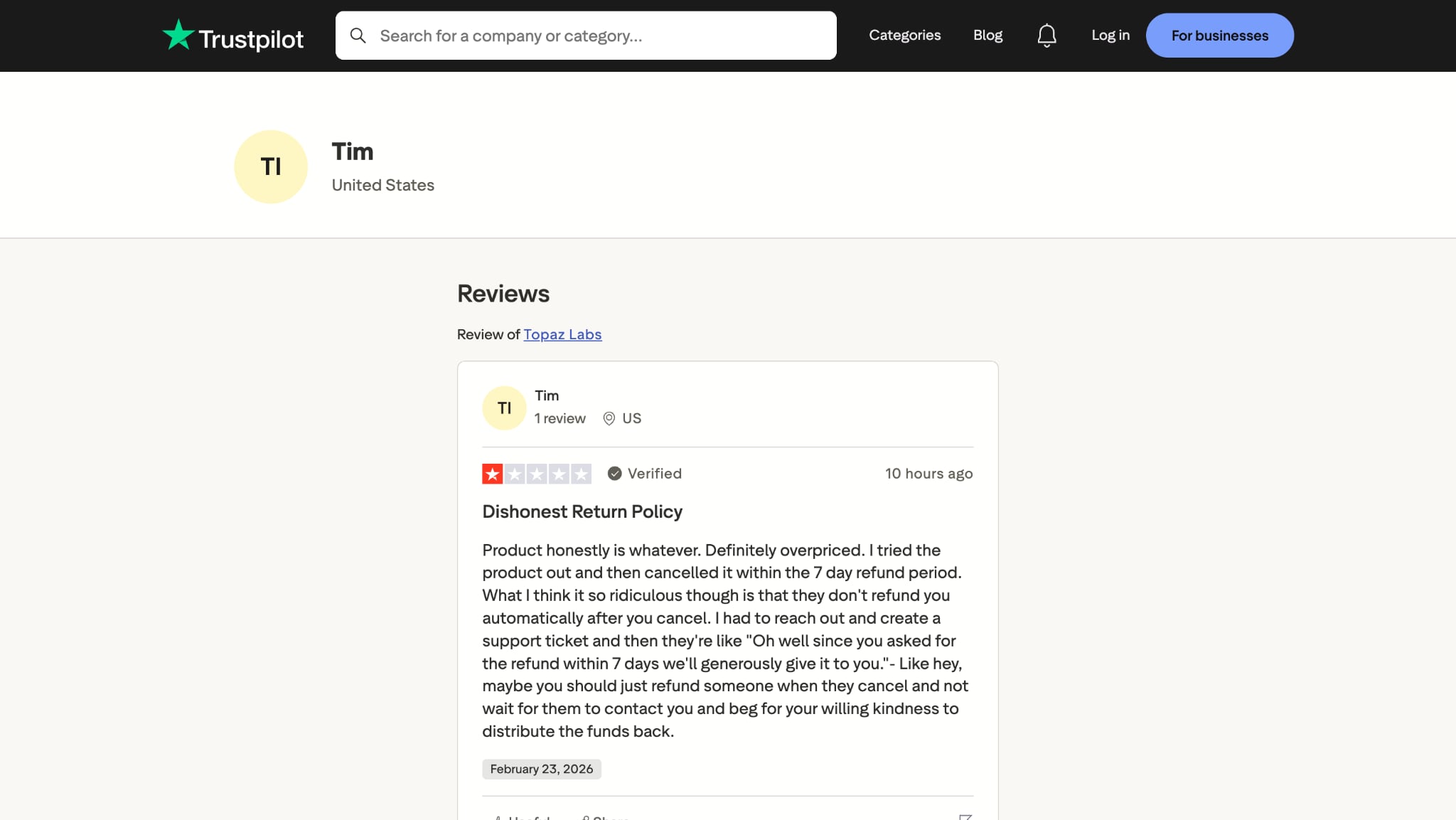
- Quite a few users complain on Trustpilot that Topaz Video AIT does not refund automatically.
- Occasional crashes, bugs, and update-related issues, particularly on macOS, can interrupt workflow.
- Older GPUs, basic laptops, or insufficient VRAM can cause errors or prevent heavier AI models from running.
Part 6: Topaz Video AI vs. Competitors: Which One Should You Choose?
Choosing the right AI video enhancer depends on your workflow, hardware, and the type of footage you work with. Topaz Video AI specializes in professional-grade enhancement, while competitors offer either more automation, integration with existing suites, or lighter hardware requirements.
At a glance:
- Wondershare UniConverter Video Enhancer: AI enhancement is built into an all-in-one media suite for converting, compressing, and editing videos. Offers speed and convenience for mid-range systems.
- Topaz Video AI: Professional, AI-focused tool with advanced models for upscaling, denoising, frame interpolation, and SDR-to-HDR conversion. Ideal for restoring archival or low-resolution footage.
- AVCLabs Video Enhancer AI: Automated enhancer with strong AI under the hood. Easier for beginners while still capable of upscaling SD to 8K.
- DVDFab Enlarger AI/UniFab AI Video Enhancer: Integrated AI upscaling within DVDFab’s disc-ripping and media conversion ecosystem. Best if you already use DVDFab tools.
Topaz Video AI vs. Wondershare UniConverter Video Enhancer
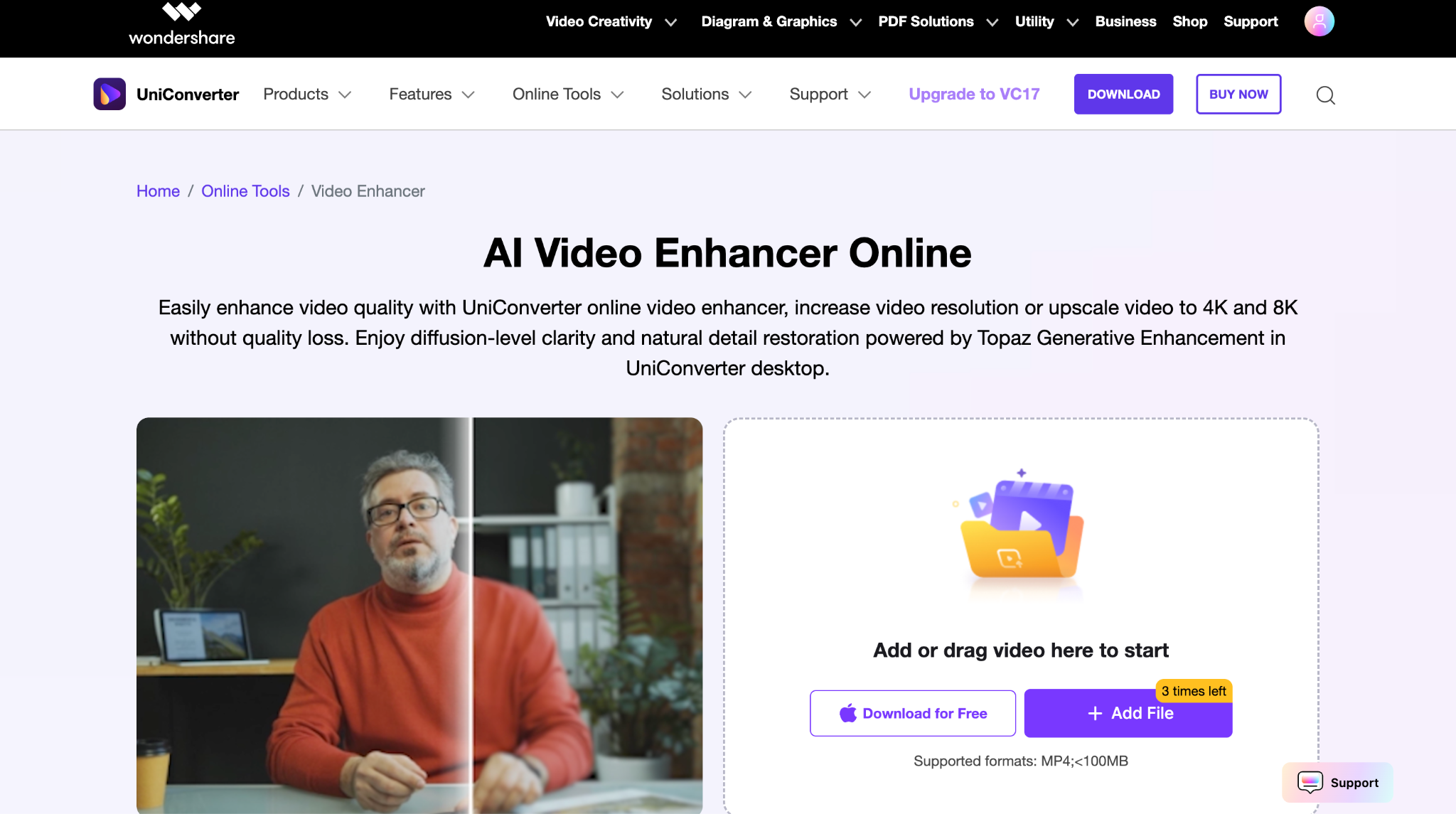
Here you will get a comparison between a specialist AI enhancer and an all‑in‑one media toolbox that includes AI features. The best choice depends on whether you value deep control over models or a faster, unified workflow.
Best Alternative to Topaz Video AI
AI Enhancement Depth
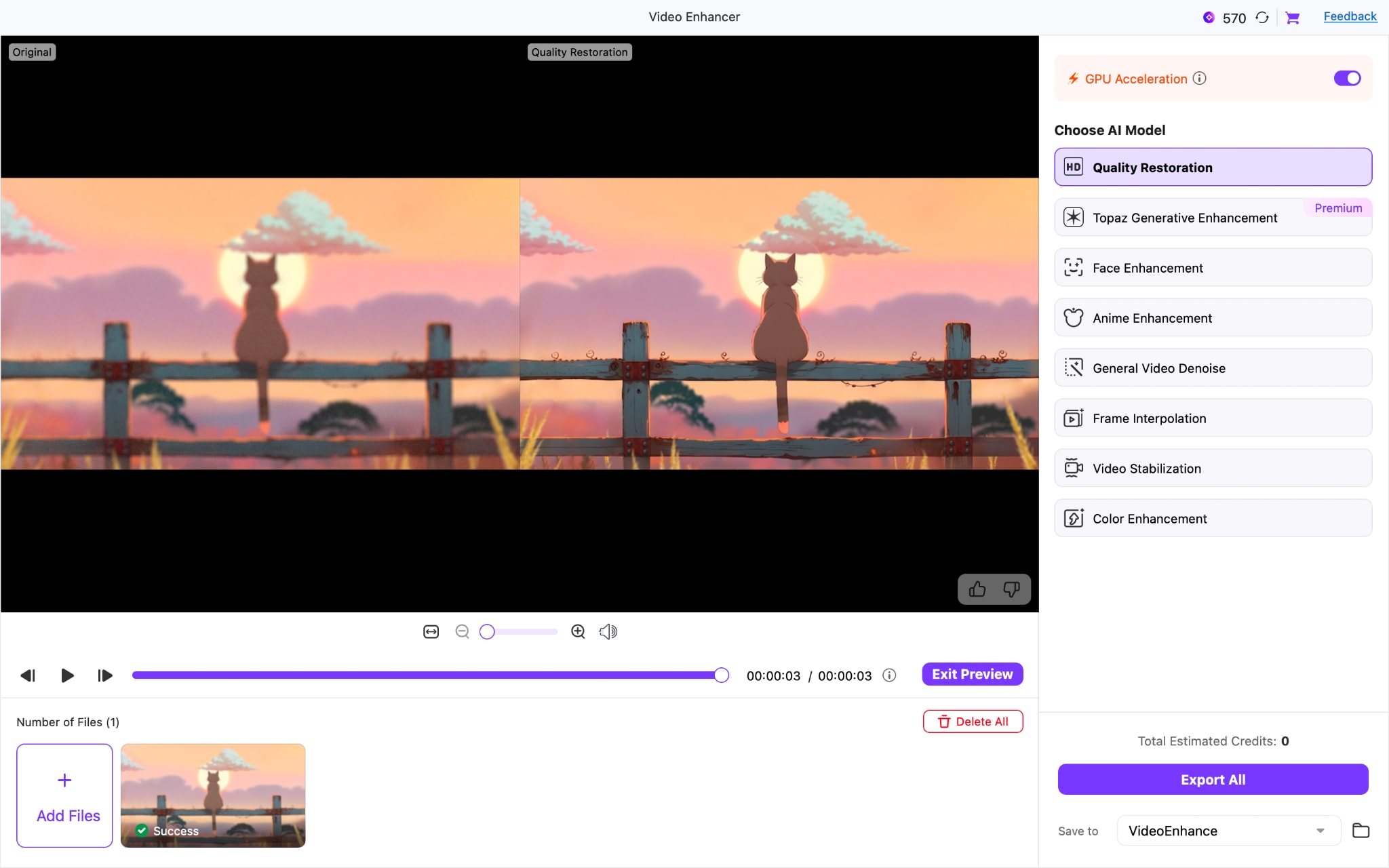
AI enhancement uses trained models to reconstruct missing detail, reduce noise, sharpen edges, correct color, and upscale resolution based on learned visual patterns.
Topaz Video AI is structured around multiple specialized AI models for upscaling, denoising, deinterlacing, stabilization, SDR-to-HDR conversion, and frame interpolation. You choose which model handles each task and can combine processes depending on the footage type. This approach is particularly useful when working with archival material, VHS transfers, or low-bitrate sources where detail recovery and motion consistency matter.
Wondershare UniConverter Video Enhancer applies AI in a more guided way. It focuses on improving clarity, brightness, resolution, and color balance through preset modes such as quality restoration or face enhancement. It supports automated upscaling up to 4K/8K and integrates AI enhancement alongside compression and conversion tools. The system minimizes manual tuning and prioritizes predictable, fast improvements over deep model experimentation.
In practical terms, Topaz offers deeper model customization. Wondershare UniConverter prioritizes controlled automation.
Ease of Use and Workflow
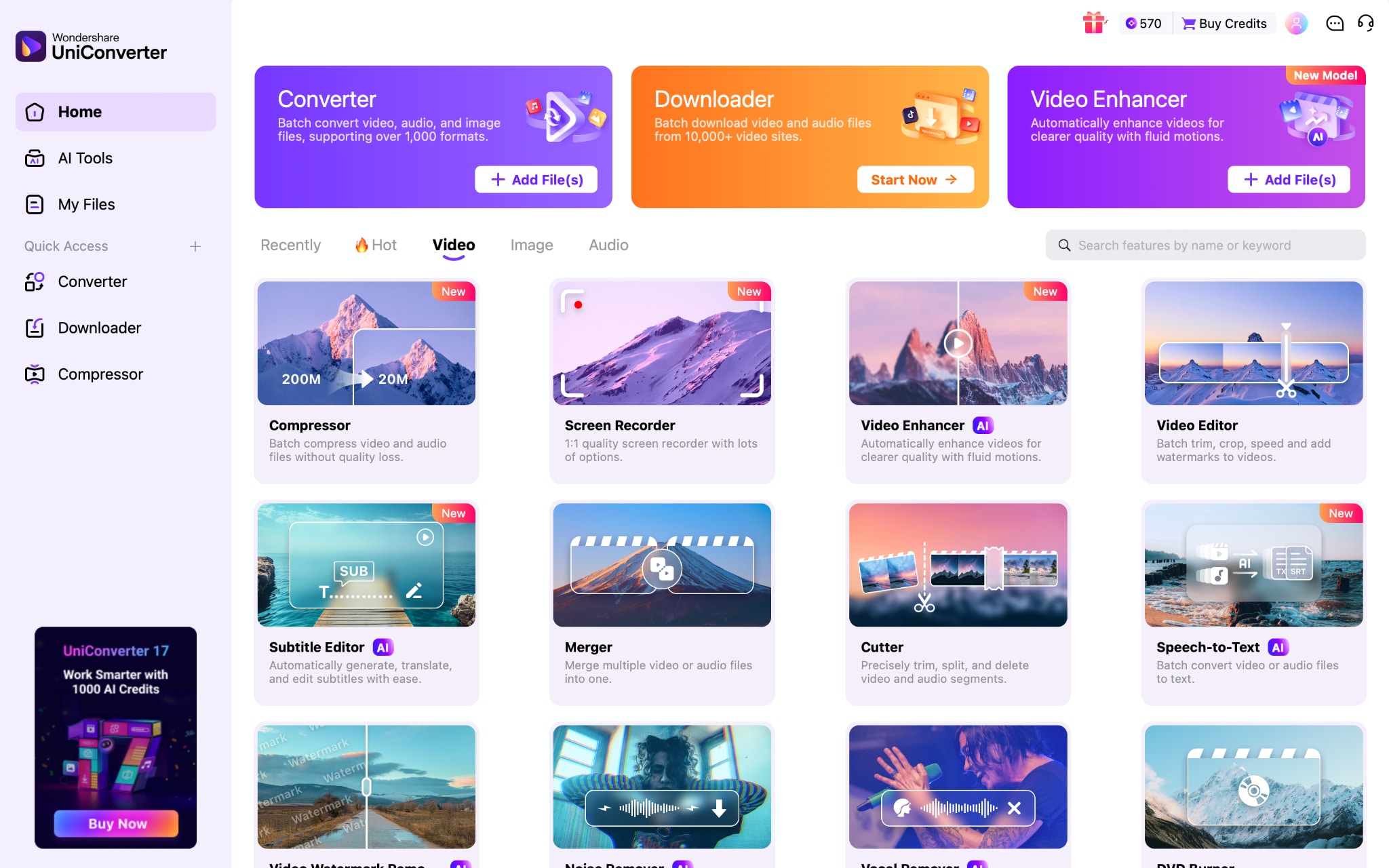
Topaz treats enhancement as a dedicated production stage. You import footage, select the appropriate AI model, adjust parameters, preview, and export a processed file. That file is typically moved back into your editing pipeline. This workflow gives precision but adds an extra step and requires familiarity with model selection.
Wondershare UniConverter keeps everything inside one interface. You can enhance, compress, convert, and edit within the same session. AI modes are preset-driven, so you select a mode, process the file, and continue with format conversion or compression without switching applications. This reduces friction for users who handle high volumes of everyday media tasks.
Topaz rewards users willing to invest time in model selection. UniConverter reduces operational complexity.
Hardware Requirements
Topaz Video AI performs best on systems with:
- Dedicated DirectX 12 compatible GPU
- 16–32 GB RAM
- 6–16 GB VRAM, depending on the AI model
Topaz Video AI’s heavier AI models are designed for high GPU utilization, and performance scales directly with VRAM capacity.
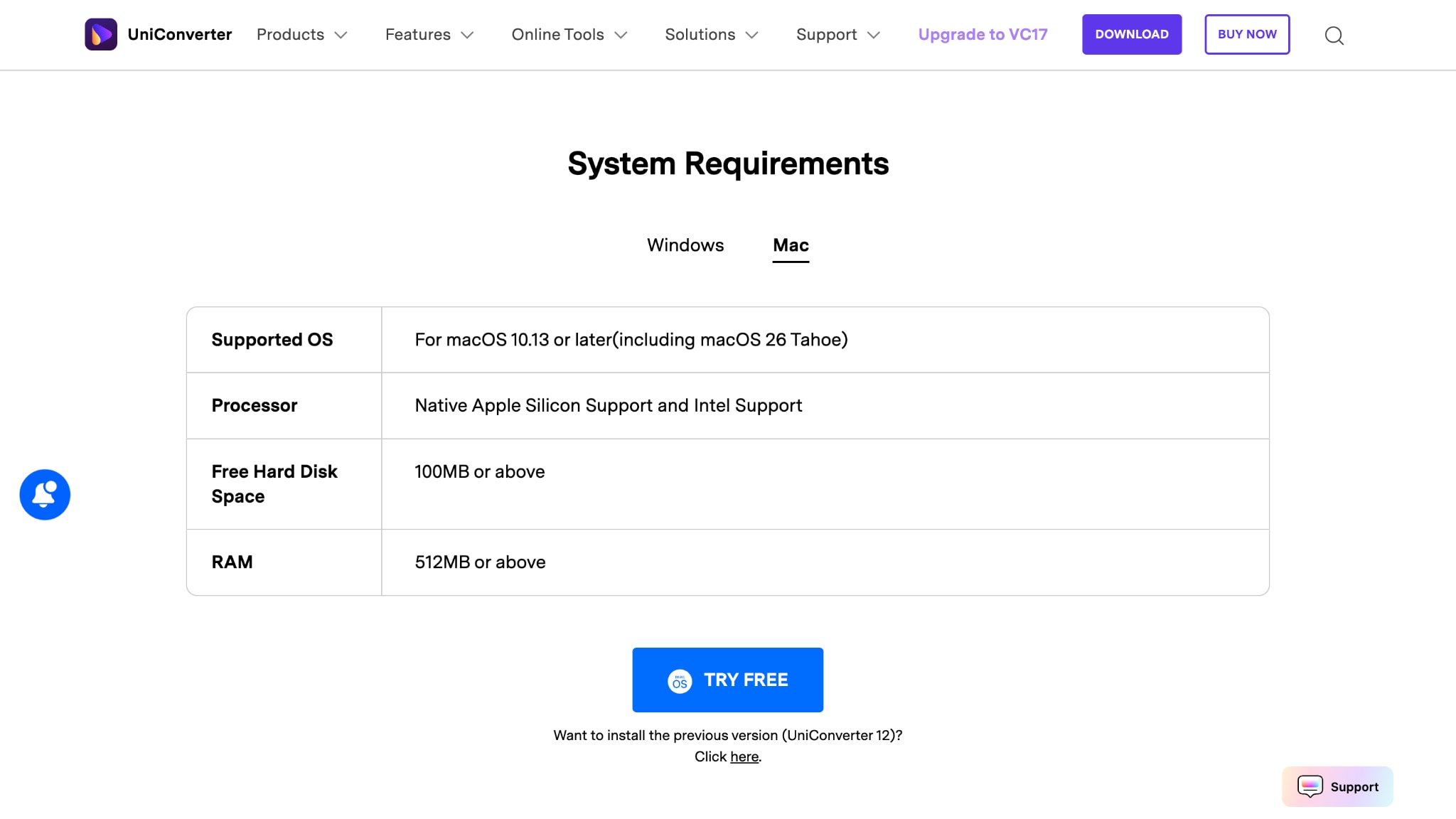
Wondershare UniConverter supports significantly lighter base system requirements and benefits from GPU acceleration when available. While it can leverage NVIDIA, AMD, or Intel GPUs for faster processing, it does not assume high-end hardware as a baseline. This makes it more accessible for mid-range desktops and laptops.
If you have a powerful GPU and want to push detail reconstruction, Topaz makes better use of that hardware. If you are working on a mid-range system, Wondershare UniConverter is generally easier to run comfortably.
When to Choose Topaz Video AI?
- Need maximum detail recovery from degraded footage
- Restore archival, VHS, or historical material
- Want model-level control over denoising, sharpening, and motion
- Have a high-end GPU and sufficient VRAM
When to Choose UniConverter Video Enhancer?
- Want quick and consistent visual improvements
- Need batch processing combined with format conversion
- Prefer an all-in-one media toolkit
- Work on mid-range hardware and value workflow speed
Best Alternative to Topaz Video AI
Topaz Video AI vs. AVCLabs Video Enhancer AI
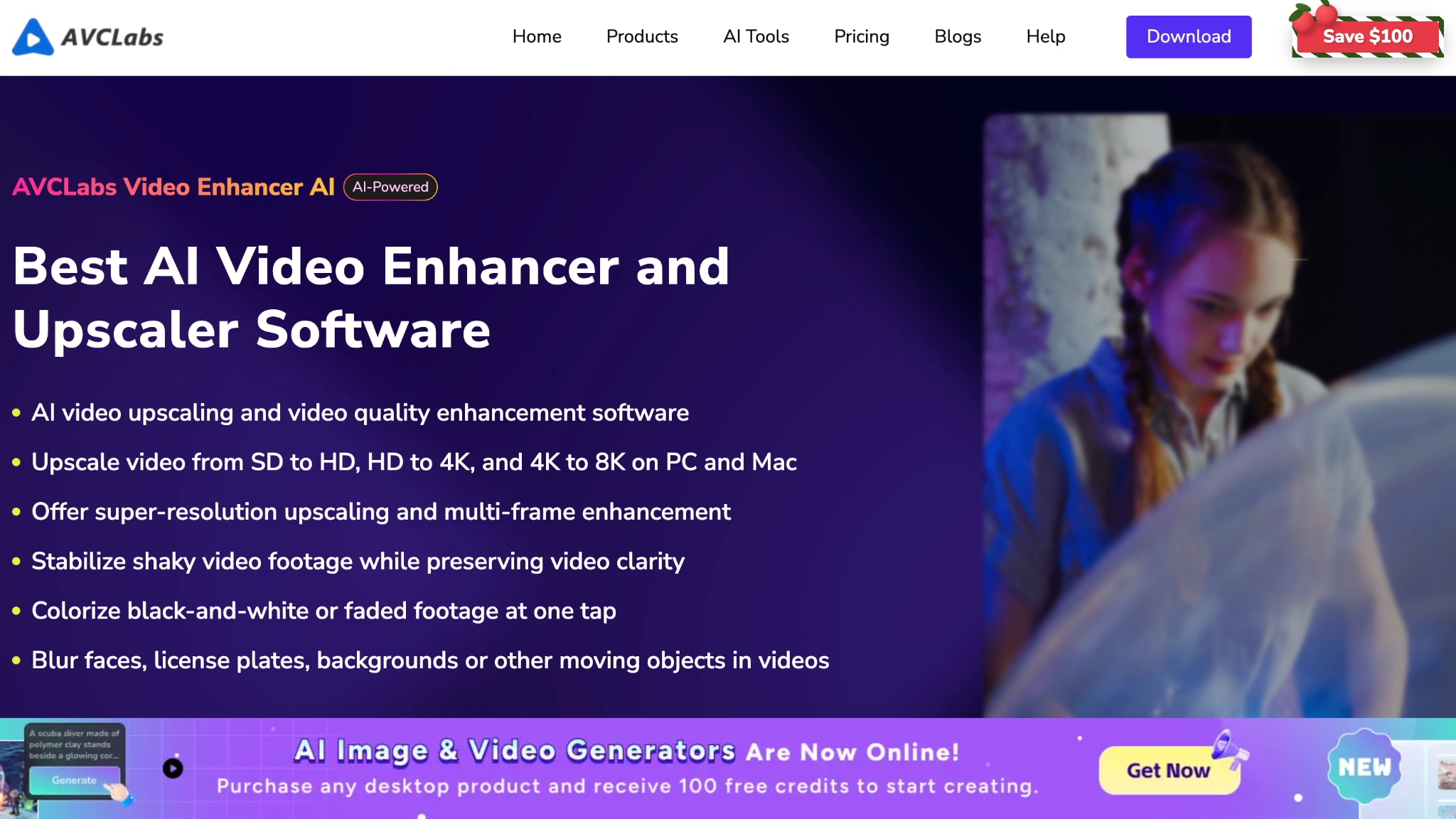
Both Topaz Video AI and AVCLabs Video Enhancer AI aim for high-end AI upscaling but differ in customization, ease of use, and target users.
AI Upscaling Quality
Topaz Video AI offers professional-grade enhancement with multiple named AI models for denoising, sharpening, deinterlacing, frame interpolation, and stabilization. You can choose specific models for each task, giving granular control over how your footage is enhanced.
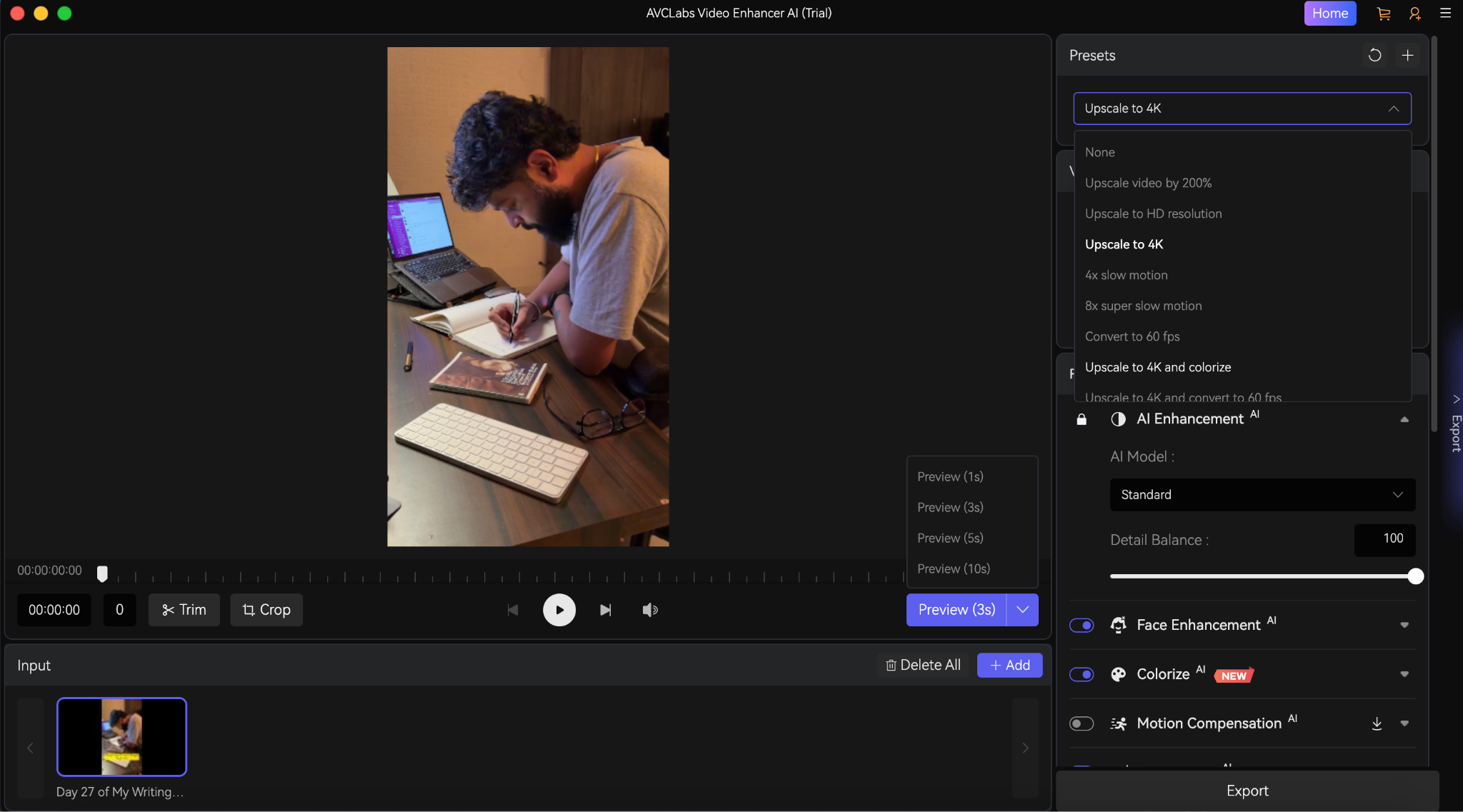
AVCLabs Video Enhancer AI uses automated deep-learning models, including GANs and transformers, to upscale videos from SD to 4K and 8K. It also includes AI face enhancement, motion-aware stabilization, and automatic blur for privacy protection. While AVCLabs produces advanced results, much of the decision-making is handled through guided presets rather than model-level selection.
Processing Speed
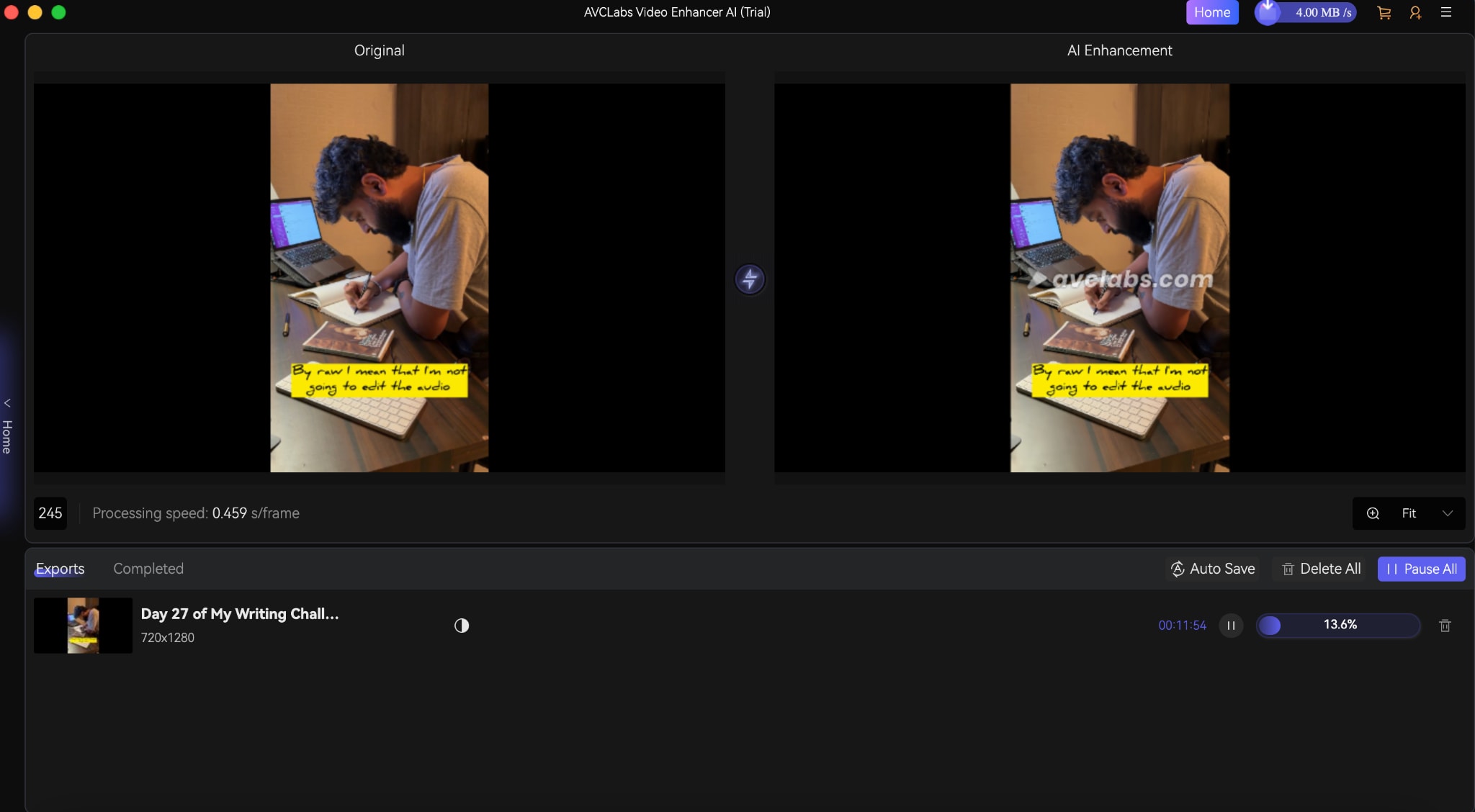
Both tools rely heavily on GPU performance. Topaz offers optional cloud rendering to offload heavy tasks, while AVCLabs provides a real-time preview. The export process is slow, and it took almost 5 minutes to download a 1-minute video, as slow as Topaz Video AI. Performance scales with GPU quality and VRAM capacity.
Hardware Requirements
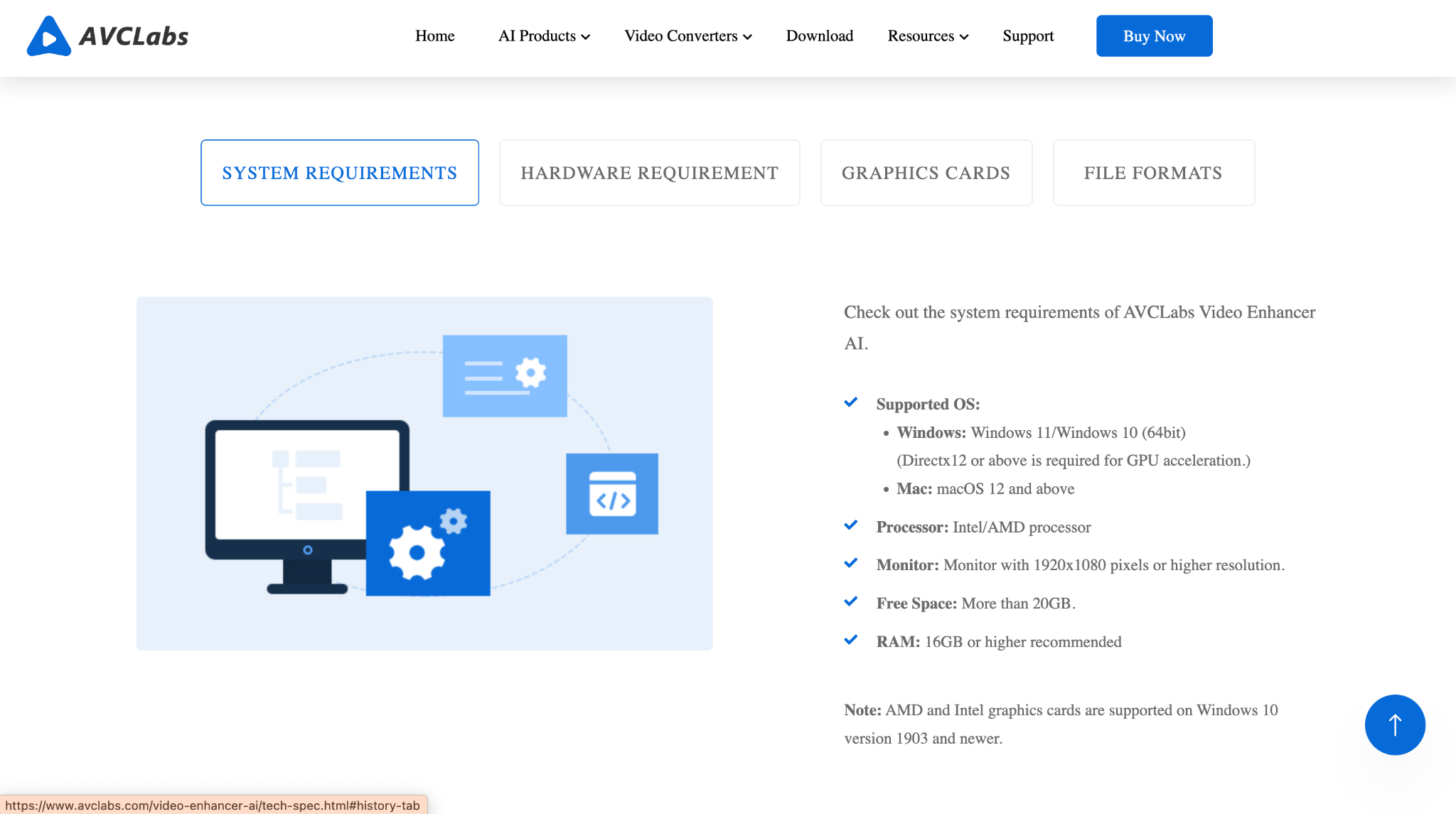
Topaz Video AI recommends a DirectX 12 GPU, at least 16 GB RAM, and modern CPUs. Advanced models can require 8–16 GB VRAM. AVCLabs recommends similar specs, supporting NVIDIA, AMD, and Intel GPUs, with a GTX 1050 Ti minimum and RTX 3060 or higher for optimal performance.
Ease of Use
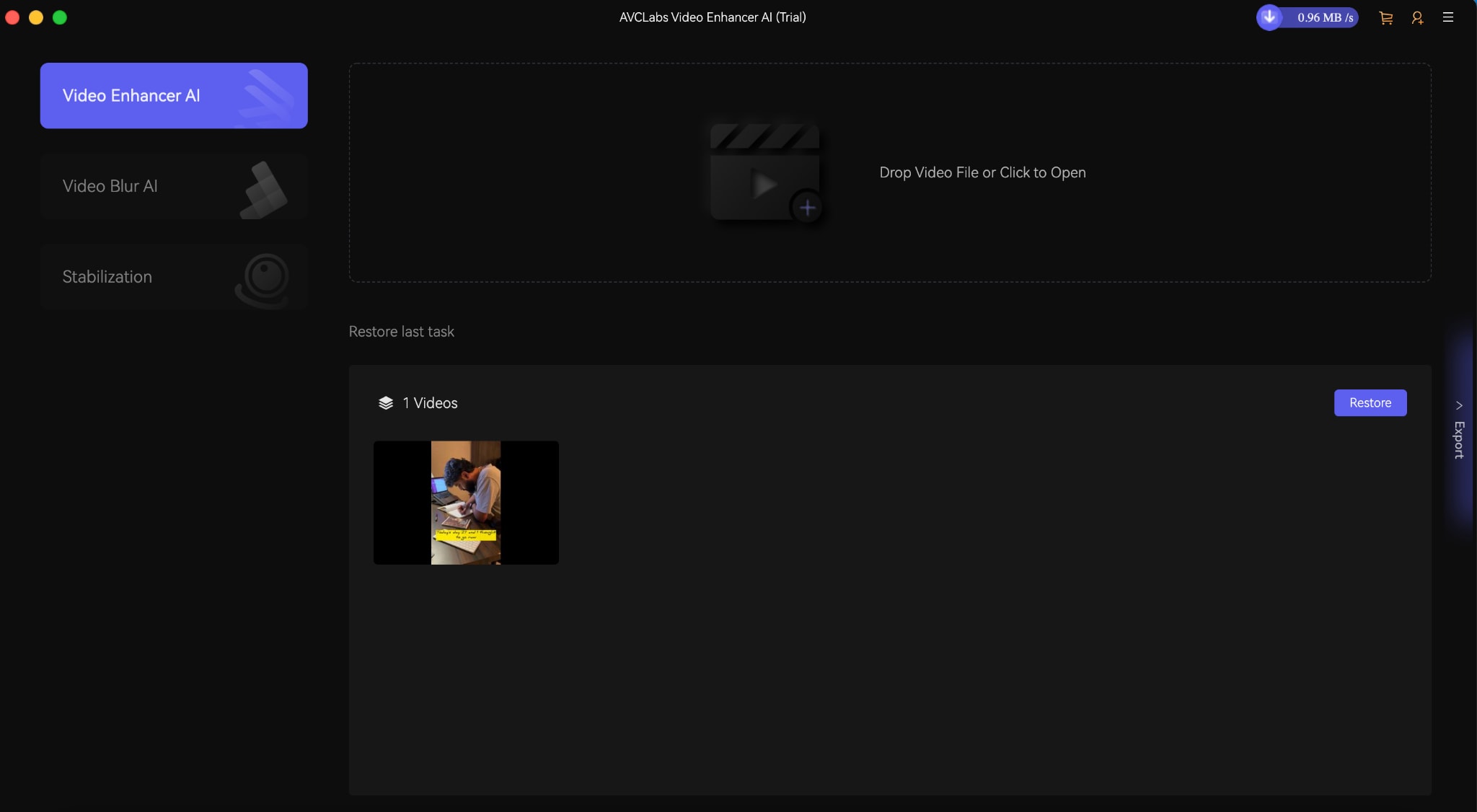
Topaz Video AI is professional-focused, with presets for beginners but a learning curve for full model customization. AVCLabs Video Enhancer AI is more beginner-friendly, with automated workflows that deliver strong results without manual tuning.
Comparison Table: Topaz Video AI vs. AVCLabs Video Enhancer AI
| Feature | Topaz Video AI | AVCLabs Video Enhancer AI |
| AI Upscaling | Advanced models for upscaling, denoising, deinterlacing, and frame interpolation | Automated deep-learning upscaling, face enhancement, and motion stabilization |
| Processing & Speed | Local rendering, optional cloud, GPU-heavy | Local GPU acceleration, real-time preview, fast export |
| Hardware Needs | DirectX 12 GPU, 16 GB RAM, 8–16 GB VRAM recommended | Dedicated GPU (GTX 1050 Ti+), 16 GB RAM, modern CPUs |
| Ease of Use | Presets + advanced model control; learning curve | Guided workflows, beginner-friendly |
Topaz Video AI vs. DVDFab Enlarger AI
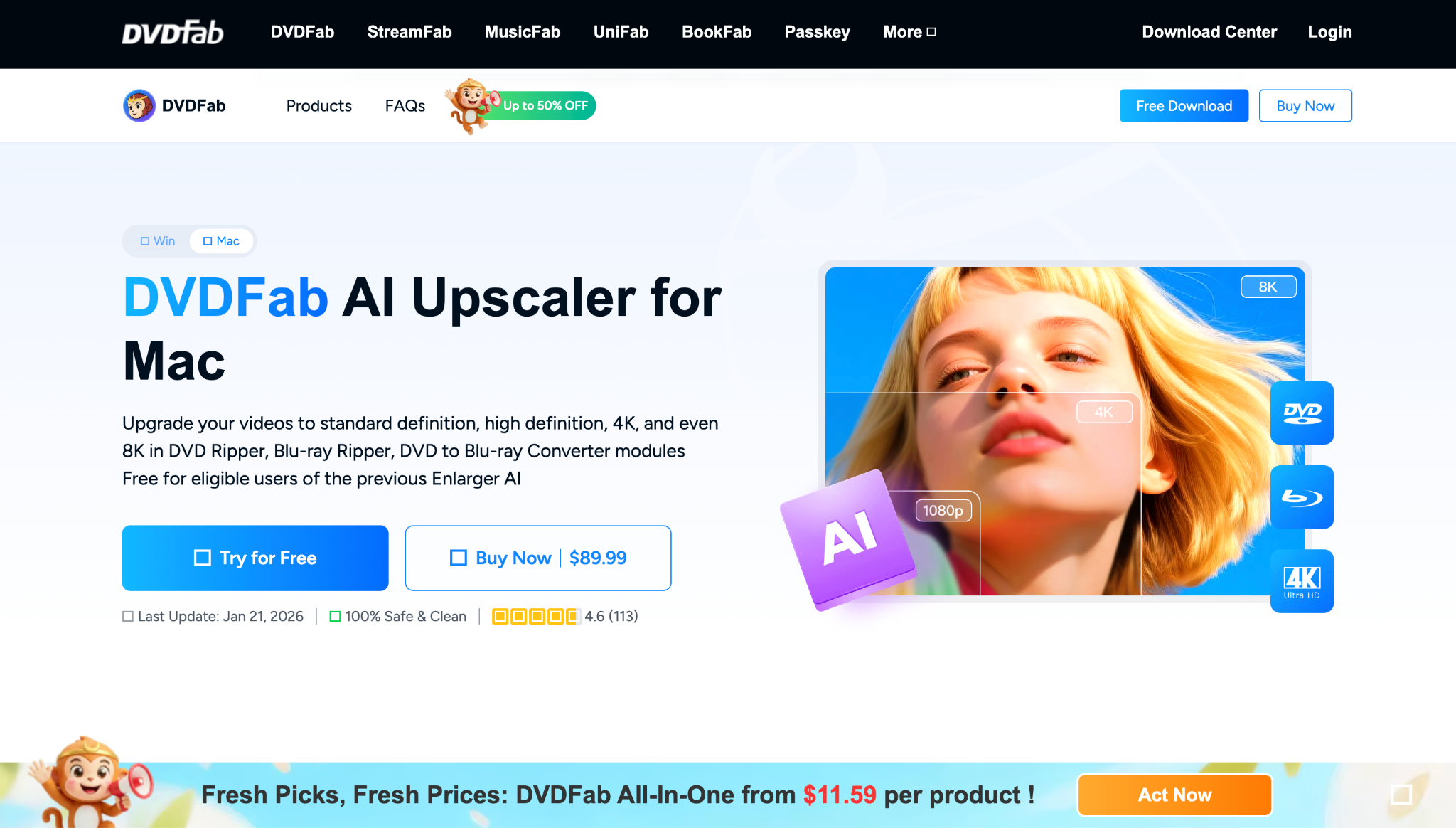
Topaz Video AI vs. DVDFab Enlarger AI comparison looks at a dedicated AI restoration tool versus an AI upscaling module built into a disc and media processing ecosystem.
Upscaling Performance (1080p → 4K and Beyond)
Topaz Video AI is designed for advanced restoration and upscaling across a range of source types, including archival, VHS, and low-bitrate footage. It uses dedicated AI models for denoising, sharpening, deinterlacing, and frame interpolation, allowing more controlled detail reconstruction when scaling to 4K or higher.
DVDFab Enlarger AI began as an SD-to-1080p DVD enhancement solution and now supports 4K and 8K output. Its AI improves sharpness and color frame by frame, particularly within DVD and Blu-ray conversion workflows. The focus remains closely tied to disc-based media.
Topaz is more restoration-oriented, while DVDFab’s AI is more focused on disc upgrades.
Integration Within Broader Media Suites
Topaz Video AI works as a standalone desktop application. You enhance footage separately and export it back into your editing workflow.
DVDFab Enlarger AI runs inside DVDFab modules such as DVD-to-Blu-ray conversion. AI upscaling becomes part of the ripping or conversion process, reducing the need for separate enhancement steps.
If you already work inside DVDFab, its integration feels more seamless.
Licensing Model
Topaz Video AI is offered under a subscription-based model. Access to the software and ongoing updates is tied to an active plan, meaning continued use depends on maintaining the subscription.
DVDFab AI Upscaler follows a different structure. It provides both time-based licenses and lifetime licenses for a single computer, and it can also be accessed as part of the broader DVDFab All-In-One bundle. This allows users to choose between licensing just the AI upscaling module or obtaining a full disc-processing suite.
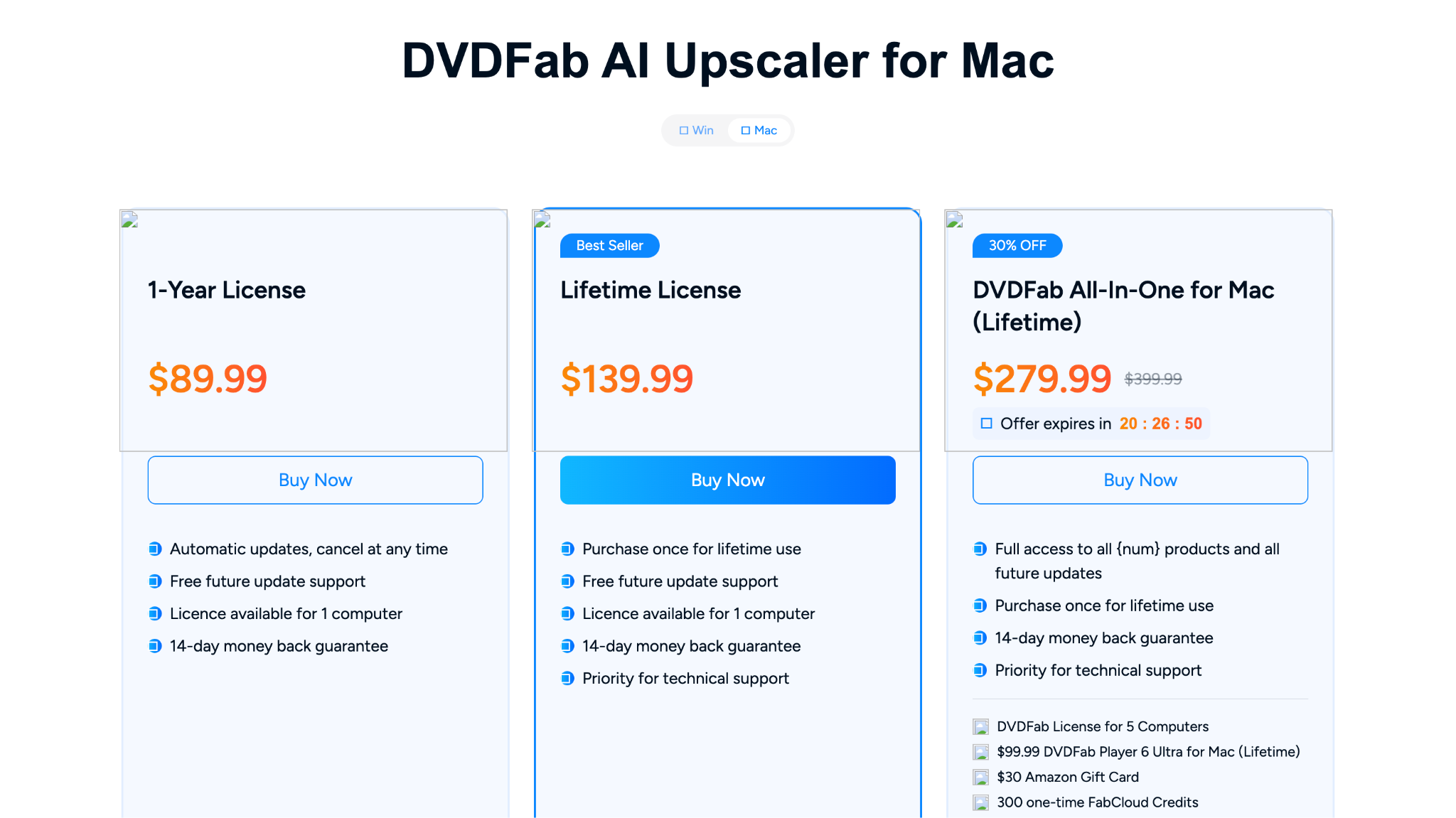
In short, Topaz operates on a subscription-centered access model, while DVDFab offers modular and lifetime licensing flexibility.
Workflow Simplicity
Topaz treats enhancement as a dedicated stage where you select AI models, adjust settings, and export the final file. DVDFab embeds AI upscaling directly into disc conversion workflows, making it simpler for users focused primarily on upgrading DVDs or Blu-rays.
In practical terms, Topaz offers greater flexibility in enhancements, while DVDFab prioritizes ecosystem efficiency.
To simplify your decision, here’s a side-by-side comparison of all four tools across key factors, including AI control, hardware requirements, workflow style, and licensing.
| Tool | Best For | AI Control Level | Hardware Demand | Workflow Style | Licensing |
| Wondershare UniConverter Video Enhancer | Fast AI enhancement + conversion toolkit | Preset-driven | Moderate (GPU acceleration optional) | All-in-one media suite | Subscription or perpetual + AI credits |
| Topaz Video AI | Professional restoration & 4K+ upscaling | High (multiple named AI models) | High (dedicated GPU recommended) | Standalone enhancement stage | Subscription (Topaz Studio plans) |
| AVCLabs Video Enhancer AI | Automated AI upscaling with strong results | Medium (guided presets) | High (dedicated GPU recommended) | Dedicated enhancer | Monthly, yearly, or perpetual license |
| DVDFab Enlarger AI | DVD/Blu-ray ecosystem enhancement | Moderate (integrated AI module) | Moderate–High | Integrated inside DVDFab workflows | Module purchase or DVDFab 365 |
When Should You Choose an Alternative to Topaz Video AI?
Even though Topaz Video AI review across workflows shows strong enhancement quality and model control, it isn’t the best fit for everyone. There are clear situations where choosing an alternative makes practical sense, especially if speed, simplicity, or hardware limitations are top priorities.
If rendering feels slow, an alternative may be more suitable. Topaz relies heavily on GPU acceleration, and without a capable graphics card and sufficient VRAM, export times can increase significantly. If your system struggles to run it smoothly or you do not want to invest in high-end hardware, a lighter AI enhancer or a cloud-based solution can reduce processing pressure by either optimizing performance or shifting the workload off your machine.
Another common situation is when you only need straightforward upscaling. If the goal is to improve clarity for YouTube uploads, repurpose older clips, or upscale to 4K without adjusting advanced models, a simplified tool can deliver faster results with less configuration. In these cases, deep model customization may add complexity without adding proportional value.
Content creators who manage frequent uploads may also prefer an all-in-one workflow. Tools like Wondershare UniConverter combine enhancements, compression, conversion, and basic editing in a single interface. This reduces app switching and keeps production efficient, especially for batch processing.
In short, consider an alternative if your priority is faster rendering, lower hardware requirements, simpler upscaling, or an integrated editing workflow rather than maximum restoration control.
Common User Questions about Topaz Video AI
Is Topaz Video AI worth it for YouTube creators?
It depends on your content type. Topaz Video AI is worth it if you want to restore old footage, upscale archival clips, or use advanced denoising and frame interpolation before uploading. For standard 1080p or 4K content shot on modern cameras, the improvement may be marginal compared to the extra render time. Many YouTube creators prefer faster, all-in-one workflows unless restoration quality is a priority.
Does Topaz Video AI require a powerful GPU?
Yes. Topaz Video AI relies heavily on GPU acceleration. A dedicated graphics card with sufficient VRAM is strongly recommended for stable performance. Systems with integrated graphics or low VRAM may experience slow renders, preview lag, or model limitations. While it can run on supported hardware, performance scales directly with GPU capability.
Can Topaz upscale 480p to 4K?
Yes, it can upscale 480p to 4K using its AI models. However, upscaling does not recreate true lost detail. The software predicts and reconstructs texture and edges based on training data. Results can look significantly sharper and cleaner than basic scaling, but quality depends on the source condition, compression artifacts, and noise levels.
Is Topaz Video AI better than Premiere Pro?
Both Topaz Video AI and Premiere Pro serve different purposes. Topaz Video AI specializes in AI-based enhancement such as upscaling, denoising, deinterlacing, and frame interpolation. Adobe Premiere Pro is a full professional editing suite with timelines, effects, color grading, and audio tools. Premiere includes some AI-powered features, but it is not designed primarily for deep restoration. Many professionals use Topaz as a preprocessing step before editing in Premiere Pro.
How long does Topaz Video AI take to render?
Rendering time varies by resolution, model selection, and hardware. On mid-range GPUs, upscaling from 1080p to 4K can take significantly longer than real-time, especially with advanced models enabled. Longer clips or higher resolutions further increase processing time. High-end GPUs reduce render time, but AI enhancement is computationally intensive by design.
Conclusion: Is Topaz Video AI Worth It?
This Topaz Video AI review shows that the software delivers strong AI-powered upscaling, denoising, and motion enhancement for users who prioritize maximum visual restoration. It performs best on powerful systems and is particularly effective for archival footage, SD-to-4K conversion, and advanced detail recovery. However, it requires high GPU resources, longer render times, and a paid subscription.
So, is Topaz Video AI worth it? If you need deep control, advanced AI models, and professional-grade restoration quality, and you have the hardware to support it, it stands out as one of the best AI video upscaler options available. For simpler workflows or mid-range hardware, alternatives like Wondershare UniConverter may be more practical.