
Instagram Video Converter: How to Prepare Videos for Posting
by Christine Smith • 2026-10-27 20:56:02 • Proven solutions
Need to convert a video for Instagram because it will not upload, has no sound or appears in the wrong shape? This guide focuses on preparing a local file for Reels, Stories and posts with UniConverter Desktop. It explains format settings, editing choices and result checks before you publish.
- Part 1. Instagram Video Formats and Practical Export Settings
- Part 2. How to Convert Video for Instagram with UniConverter
- Part 3. Fix Upload, Audio and Framing Problems
- Part 4. Instagram Video Converter FAQs
Part 1. Instagram Video Formats and Practical Export Settings
An extension such as .mp4 identifies the container, not every codec inside it. Changing a filename does not re-encode the video or fix an unsupported audio stream. Use the settings below as a practical starting point, then check the destination in Instagram; they are not a universal list of upload limits.

| Setting | Practical starting point | What to check |
|---|---|---|
| Container and video | MP4 with H.264 video | A compatible extension alone is not enough. Re-encode when the streams inside the file are the problem. |
| Audio | AAC, keeping the intended soundtrack | Listen for silence, clipping and sync drift. Avoid carrying through an incompatible audio codec. |
| Reels and Stories framing | 9:16; 1080 × 1920 when appropriate for the source | Preview the full frame and keep faces or text clear of interface overlays. This is a working recommendation, not a universal requirement. |
| Frame rate | 30 fps as a practical export choice | Check motion before changing the source rate. Raising a low source frame rate does not automatically add useful motion detail. |
| Bitrate | Use an appropriate quality preset, then adjust if needed | There is no single bitrate that guarantees both a small file and unchanged detail for every video. |
| Size and duration | Check the actual app or publishing service | Reels, Stories, carousel posts, ads and API uploads should not share one assumed cap. |
Settings checked October 27, 2026. Meta’s official Instagram API collection lists MP4/MOV containers, H.264 or HEVC video and AAC audio for Reels API publishing. API rules are not a substitute for the requirements shown in the Instagram app or your scheduling service.
Convert the Format, Resize the Frame or Compress the File?
- Format conversion: use it when the container or codecs cause compatibility problems.
- Crop or resize: use it when the video is sideways, the frame is unsuitable or the subject is cut off.
- Compression: use it when the file is too large. Start from the original and review detail after exporting.
Part 2. How to Convert Video for Instagram with UniConverter
Use Wondershare UniConverter Desktop when you need to convert local videos and review their output settings before posting. It can prepare supported files in a queue, with Trim and Edit options for checking the useful segment, crop and orientation. Keep the original: changing codecs, dimensions or bitrate can change visual quality.
For a single clip that already plays and uploads correctly, conversion may be unnecessary. For repeated jobs, the desktop queue makes it easier to prepare several videos, but review each framing and audio choice individually. This article describes desktop software; it does not provide an online Instagram download or conversion widget. Trial and paid features follow the current product terms.
 Wondershare UniConverter - Your Complete Video Toolbox for Windows/Mac
- Convert supported local MOV, MP4, AVI, WMV and other videos to a suitable output profile.
- Adjust output settings to balance compatibility, size and visible quality.
- Trim unwanted sections and preview crop or orientation changes before conversion.
- Use the desktop Converter for local files; link-based saving is a separate workflow.
- Prepare the exported file for the phone or computer you use to publish.
- Convert multiple supported files in a desktop queue, then check each result.
- Use a separate compression workflow when file size remains the main problem.
- Check the current Windows and Mac system requirements before installing.
 UniConverter Desktop. Check the current trial terms before using paid features.
Instagram Video Converter: Desktop Workflow
The current Windows Converter guide uses Convert to and Convert All. The original screenshots below show an earlier interface; follow your installed version’s controls. Conversion prepares the local file and does not publish it to Instagram.
Step 1 Open Wondershare UniConverter and Add Videos.
Open UniConverter Desktop, choose Converter, and add your local videos with Add Files or drag and drop. Check the source information before choosing output settings. 
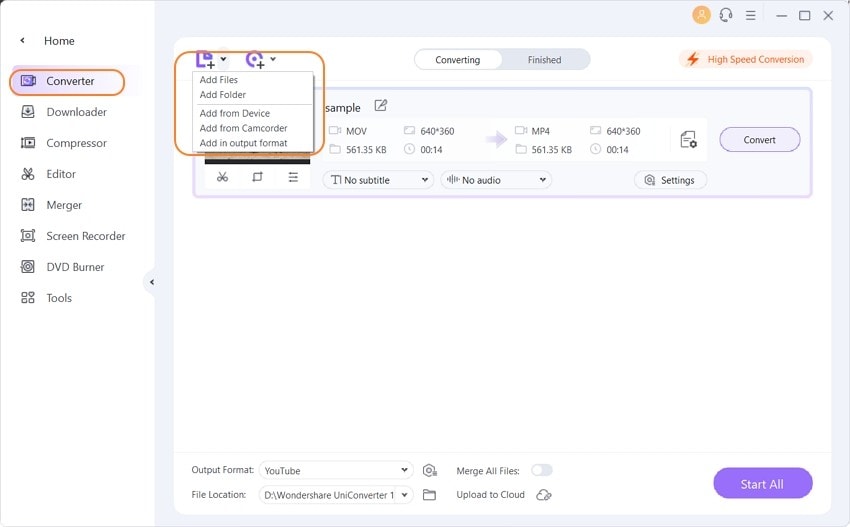
Earlier interface illustration; controls and labels may differ in the current release.
Step 2 Pick Your Output Format.
Open Convert to and choose MP4. Use the output Settings icon to review the available video and audio options. Select H.264 video and AAC audio where offered for your profile; use the export table above as your starting point. A preset named Instagram does not guarantee that its dimensions suit your intended post.
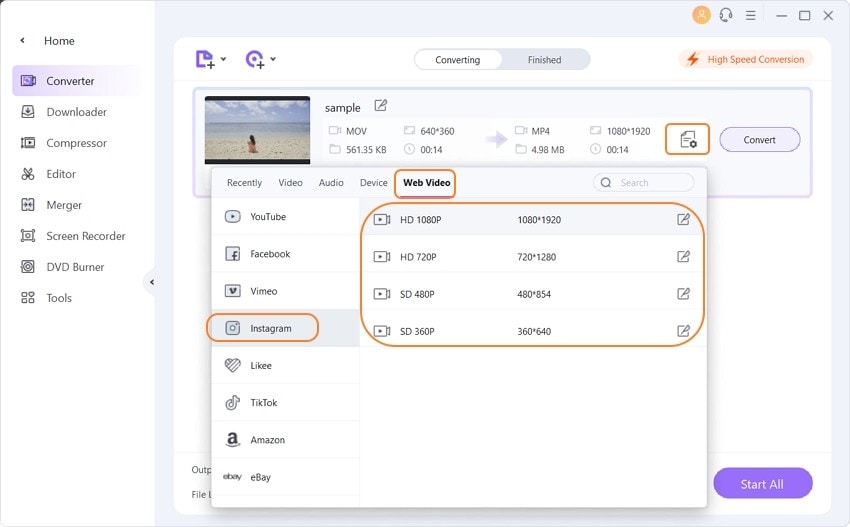
Earlier interface illustration; controls and labels may differ in the current release.
Before Converting: Trim, Crop and Check the Output Preview
Open Trim on the queued video if only a short segment is needed. Use Edit > Crop for orientation and aspect-ratio adjustments, then check the output preview before confirming. A landscape-to-vertical crop can remove people, captions or objects near the edges. Do not apply one crop blindly to a batch with different compositions.
To convert video to Instagram Story framing, prepare a vertical version and confirm the important content remains visible. For a Reel, use the same preview-first approach. A video appearing in the feed does not make every framing choice interchangeable.
Step 3 Start the Instagram Video Conversion.
Confirm your settings and click Convert All. Open Finished or the output folder to inspect the saved file. Interface labels can differ in older releases and across platforms.
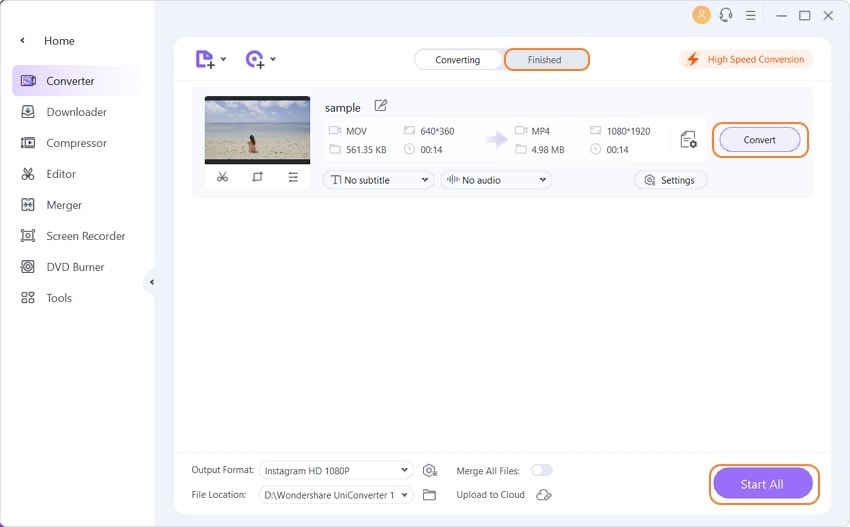
Earlier interface illustration; controls and labels may differ in the current release.
Before uploading, play the exported video from beginning to end. Check picture, soundtrack, sync, orientation and actual size. Test one file in Instagram before processing a large queue. Hardware acceleration is optional and depends on hardware, drivers and output settings; it is not required for this workflow.
Part 3. Fix Instagram Upload, Audio and Framing Problems
| Problem | Check first | Next action |
|---|---|---|
| MP4 still will not upload | Its actual video/audio codecs, size and duration | Try an H.264/AAC MP4 export, then test the saved output. Renaming the extension does not change encoding. |
| MOV will not import or upload | Which codec the MOV contains | Convert the local file to a practical MP4 profile. MOV alone does not identify its encoding. |
| Video has no sound | Whether the source contains the intended audio track | Listen locally, select the intended track and use compatible AAC output where available. Conversion cannot restore audio missing from the source. |
| Picture is cropped or sideways | Rotation and crop in the output preview | Correct orientation and review the chosen aspect ratio. Inspect faces and captions near the edges. |
| File is too large | Actual exported size and current upload allowance | Trim unnecessary footage, reduce an excessive output resolution or use compression, then compare quality. |
| Local file plays but Instagram upload fails | Connection, app status and destination-specific restrictions | Try a short test export. Format conversion does not resolve every network, account or publishing-service problem. |
For source-specific help, see MP4 to Instagram troubleshooting, MOV to Instagram conversion or WMV to Instagram conversion. These guides handle individual inputs; this page provides the overall export workflow.
Part 4. Instagram Video Converter FAQs
What is an Instagram video converter?
It is software that prepares a local video for posting by changing its format, encoding or output settings. The term can also appear in link-saving searches, but this guide covers local-file conversion before uploading.
What format should I convert a video to for Instagram?
MP4 with H.264 video and AAC audio is a practical compatibility starting point. MOV can also contain suitable media, but its extension alone does not identify the codecs. Check the requirements for your publishing route and test the export.
Why does Instagram reject my MP4?
MP4 is a container. The codecs inside, file size, duration or publishing conditions can still cause problems. Check the saved file and try a compatible export; changing .mov or .mkv to .mp4 in a filename does not convert it.
Can I convert video for Instagram online free?
Browser converters can handle supported local files, subject to their current limits. Check whether the tool exposes the output settings you need. The workflow shown here uses UniConverter Desktop, whose trial and paid features are separate from online tools.
Can I convert a landscape video to an Instagram Reel or Story?
Yes, you can prepare a vertical version by adjusting framing in a suitable editor. In UniConverter Desktop, review Edit and Crop for the queued video. Inspect the output preview carefully because a vertical crop may remove important parts of a landscape shot.
Do I need to convert a MOV file before uploading?
Not always. MOV is a container, so compatibility depends on what it contains and how you publish. If it already uploads and plays correctly, conversion may be unnecessary. If it fails, try an H.264/AAC MP4 export and check the result.
Can I convert multiple videos for Instagram at once?
UniConverter Desktop can queue supported files for conversion. Review output settings, framing and soundtrack for each clip, test one output first, then convert the rest. One crop is not suitable for every composition.
Will conversion prevent Instagram quality loss?
No converter can guarantee unchanged quality through every re-encode or upload. Keep the original, avoid unnecessary repeated exports, choose sensible dimensions and settings, and compare the saved result before publishing.
Conclusion
A useful Instagram video converter prepares the file you actually need: compatible video and audio, suitable framing and an export you have checked. Start with the original, use the desktop settings that fit the destination, and test one result in Instagram before repeating the workflow.

Tips
Need to adapt the same local video for another platform? See video conversion for Twitter/X. Check that platform’s current uploader rather than reusing Instagram assumptions.
- Export to ProRes in Adobe Premiere Pro in Easy Steps
- 2 Simple Ways to Burn VLC Files to DVD
- How to Play and Convert MTS Files with VLC
- How to Convert DTS to AC3 Easily
- MXF YouTube: Upload MXF Video to YouTube
- What is SF2 File and How to Open and Convert SF2 File
- DMG: What is DMG File and How to Open DMG File
- How to Convert WMV to Instagram in Easy Steps
- ProRes Codec for Windows: How to Export ProRes on Windows
Christine Smith
chief Editor