

All Topic
- AI Tools Tips
-
- AI Photo Enhancer Tips
- Voice Changer Tips
- AI Thumbnail Maker Tips
- AI Script Generator Tips
- Smart Summarizer
- AI Subtitle Generator Tips
- Watermark Remover
- Vocal Remover Tips
- Speech to Text Tips
- AI Video Tips
- AI Image Tips
- AI Subtitle Translator Tips
- Video Extractor Tips
- Text to Speech Tips
- AI Video Enhancer Tips
- DVD Users
- Social Media Users
- Camera Users
- Photography
- Creative Design
- Movie Users
- Travelling Fans
- Educational Users
- More Solutions
- Holidays and Commemoration
- Game Lovers
- Other Tips
Video to VR Converter Online/PC: Convert Normal Video to 360 VR
by Kayla Morrison • 2026-10-19 22:06:29 • Proven solutions
Can you really convert a normal video into 360 VR?
Yes, you can convert a normal video or MP4 into a VR-compatible format for headset playback, such as a 360-style, side-by-side, or over-under video. A desktop tool like Wondershare UniConverter is better for local files and repeated conversion, while an online VR video converter is useful for quick browser-based tasks. However, a converted 2D video will not become true native 360° footage because it cannot recreate missing viewpoints, real depth, or full scene coverage.
Which Video to VR Converter Method Should You Choose?
The best way to convert video to VR depends on what you want to watch, where you want to play it, and how much control you need over the output. Use the table below to choose the right workflow before starting.
| Need | Best workflow | Why it fits |
|---|---|---|
| Convert normal video or MP4 for headset playback | Desktop VR video converter | Better for local files, repeated conversion, output folders, and device-oriented settings. |
| Try a quick video to VR converter online | Online VR video converter | Useful for browser-based tests, but upload limits, account requirements, or pricing may apply. |
| Create a 3D-style VR video from 2D footage | 2D to 3D / SBS / OU workflow | Creates a headset-friendly viewing effect, but it cannot recreate true camera-captured depth. |
| Upload a real 360 video to YouTube | Native 360 footage plus correct metadata | YouTube requires proper 180° or 360° video preparation and 360 playback verification. |
Our Criteria for Choosing a Video to VR Converter
For this guide, we compared video to VR conversion methods based on how clearly they explain the output, how practical the workflow is, and whether the final video is suitable for headset playback or VR-style viewing.
Immersion Effect
We checked whether each method can make normal video feel more immersive in a headset while still explaining the limits of turning 2D footage into a VR-style experience.
Output Clarity
We looked at how clearly each workflow handles VR modes, projection expectations, headset playback, and the difference between VR-compatible output and true native 360° footage.
Workflow Flexibility
We compared whether the method is better for desktop conversion, quick online use, local MP4 files, or one-time browser-based VR video conversion.
Playback Practicality
We also considered device compatibility, output usability, and whether the result is practical enough for demos, headset playback, or casual immersive viewing.
This page gives extra weight to realistic output expectations because converted 2D video can feel more immersive, but it cannot recreate missing camera angles, real depth, or full 360° scene coverage.
This guide explains what a video to VR converter can and cannot do, how to choose between desktop and online workflows, and how to convert MP4 or normal video into a VR-compatible format for headset playback.
Convert Video to VR Convert Video to VR
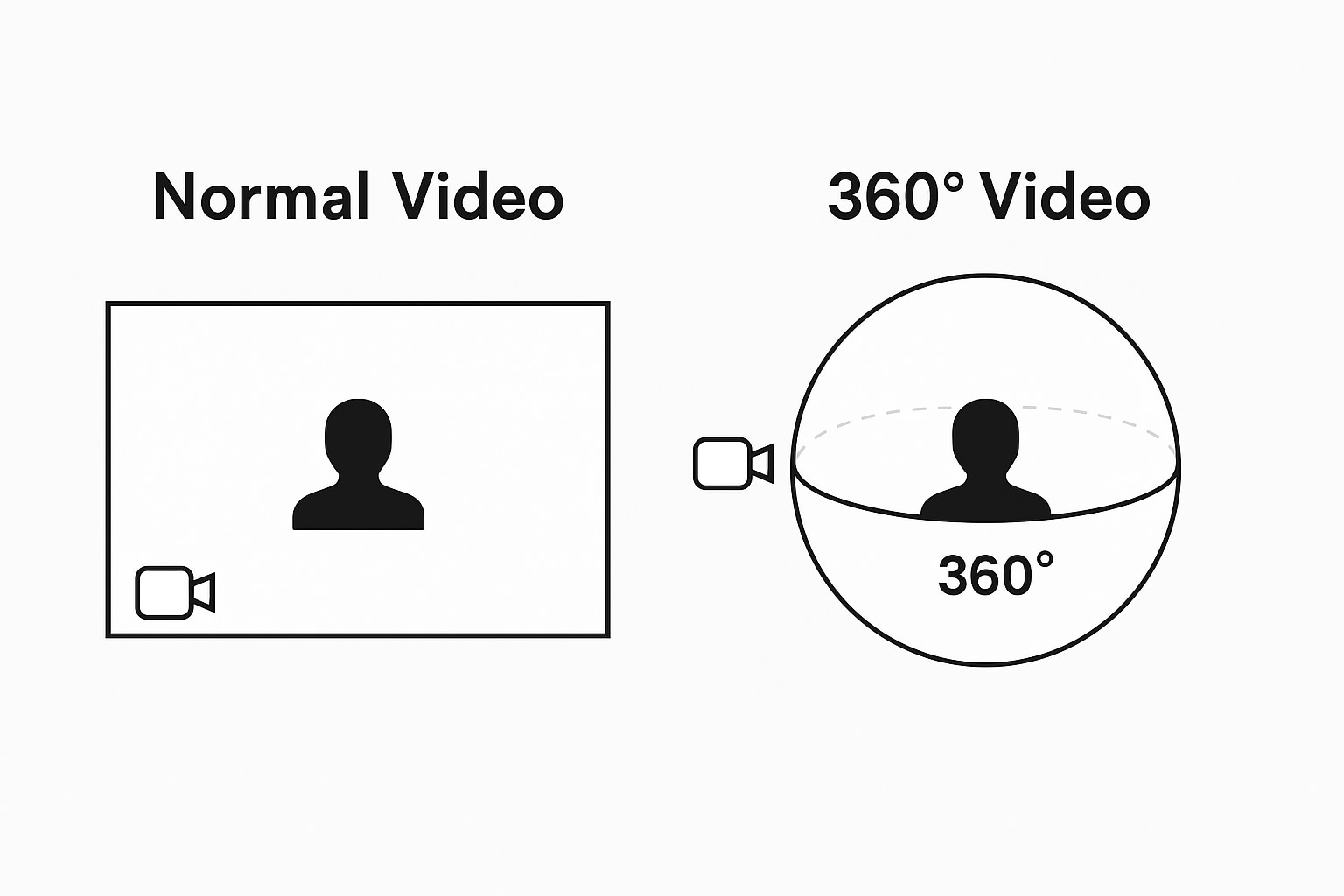
- Normal Video vs 360 VR Video: What Is the Difference?
- 360 VR, VR180, SBS, or Over-Under: Which Output Mode Should You Use?
- Best Desktop Tool to Convert Video to VR on Windows or Mac
- How to Convert Video to VR Free with Wondershare UniConverter
- How to Convert Normal Video to VR Online
- FAQs about VR Video Converter
Normal Video vs 360 VR Video: What Is the Difference?
360° VR video captures everything around the camera—front, back, left, right, up, and down. Viewers can pan or turn their head to choose where to look. A normal video shows only what the lens points at.
Key differences between Normal Video and VR Video:
-
Field of view
Normal video: a rectangular window (for example, 16:9).
360° VR: a full sphere mapped into a frame (often equirectangular). -
Control
Normal video: the editor decides every frame you see.
360° VR: the viewer drives the viewpoint in real time. -
Depth & presence
Normal video: flat perspective, even if immersive content.
360° VR: monoscopic gives “being there” feel; stereoscopic (when available) adds real depth. -
Capture & gear
Normal video: one lens is enough.
360° VR: multi-lens camera or a rig; software stitches views into one sphere. -
Playback
Normal video: screen only.
360° VR: best inside a headset; also works on phones or desktops with drag/gyro to look around.
The Limits of Converting 2D to 360 VR
Converting a flat 2D clip into “360” has hard limits. It can improve immersion, but it cannot recreate what was never captured.
-
No real 360 viewpoints
A 2D source contains only one direction. Wrapping that frame onto a sphere puts the same pixels “all around” you. When you turn, you still see that single view—just remapped. There is nothing to see behind the camera because it was never recorded. -
No true 3D
True VR depth comes from binocular disparity: two slightly different views for your left and right eyes. A 2D video has only one view. Software can guess a depth map to fake parallax, but it’s still an estimate, not ground truth. -
Head-tracking mismatch
In native VR, turning your head reveals new angles. With 2D→360, pixels often “move with you” instead of exposing new detail. This mismatch can reduce realism and, in fast scenes, may feel uncomfortable. -
Detail loss from stretching
A 1920×1080 frame spread across an entire sphere looks less sharp than when shown as a normal rectangle. Textures and small text can soften, especially at the poles of the sphere. -
Artifacts and edge errors
AI depth can produce halos around edges, warped hands, or flicker in motion. Fast action, occlusions, and thin structures are the hardest to reconstruct. -
Metadata and player expectations
To display correctly, the file needs the right projection (e.g., equirectangular) and stereo flags. Even with correct metadata, viewers may still expect true 360 capture and real depth—conversion can’t deliver that.
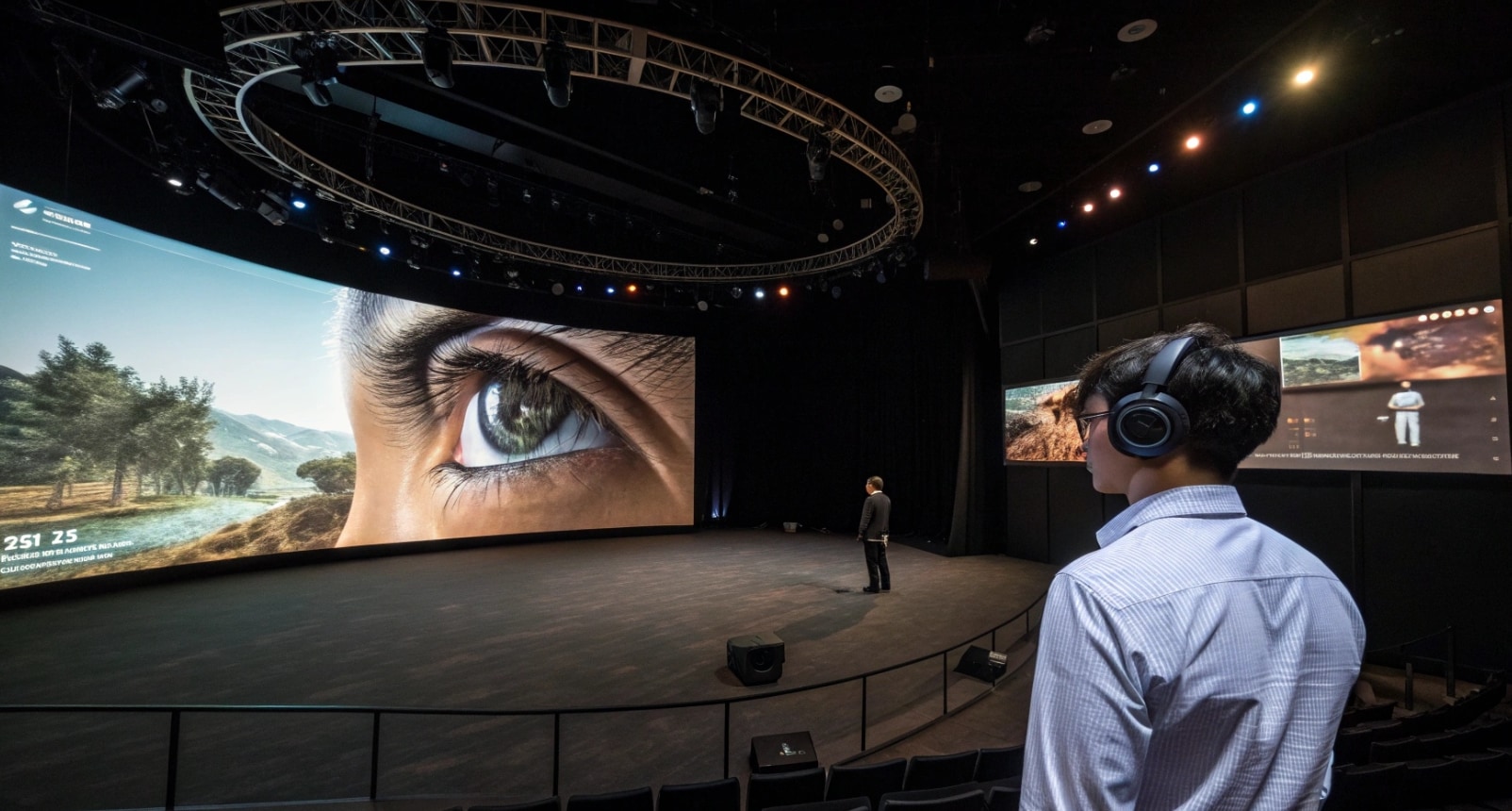
When 2D→360 is still useful
-
Virtual theater mode: Watch a flat movie on a big “virtual screen” inside a headset.
-
Ambient or slow scenes: Landscapes, slideshows, or product shots with minimal motion.
-
Contextual placement: Branding intros or background environments where realism demands are low.
360 VR, VR180, SBS, or Over-Under: Which Output Mode Should You Use?
Before you convert video to VR, it helps to understand the common output modes. A normal video can be adapted for VR-style viewing, but the best format depends on whether you want a virtual theater effect, a 3D-style headset view, or a true 360° video workflow.
| VR mode | Best for | What to know |
|---|---|---|
| 360° video | Native 360 camera footage, virtual tours, immersive scenes | Needs proper spherical projection and metadata for correct 360 playback. |
| VR180 | Front-facing immersive videos, events, tutorials, vlogs | Covers the front half of the scene and may offer stronger 3D presence when captured properly. |
| SBS / side-by-side | 3D-style headset playback from normal or 3D video | Places left-eye and right-eye views side by side for supported VR players. |
| OU / over-under | VR players that support top-bottom stereoscopic layout | Stacks the two views vertically instead of horizontally. |
| Virtual theater mode | Watching MP4 movies or regular videos in a headset | Does not create real 360° video, but can make normal videos feel more immersive. |
Best Desktop Tool to Convert Video to VR on Windows or Mac
One of the best and easiest operable video to VR converters that can be installed on your Mac or Windows computer is developed by Wondershare and is called Ani3D. Wondershare Ani3D adopts the most cutting-edge technology, and it has launched two creative features-Split Depth 3D and VR 3D video. Ani3D can present you with a breathtaking 3D video effect in a short time. Watching 3D videos without 3D glasses is no longer impossible!
How to Convert Video to VR Free with Wondershare UniConverter
Wondershare UniConverter is as efficient and robust as its other sibling, Wondershare Ani3D, and is also capable of recognizing the same number of formats for conversions as Ani3D does.
You can follow the steps below to use Wondershare UniConverter as a desktop 3D video converter for MP4, MOV, AVI, and other common video files on Windows or Mac.
Watch the Video Tutorial: How to Convert Video to VR
How to Convert MP4 or Normal Video to VR with Wondershare UniConverter
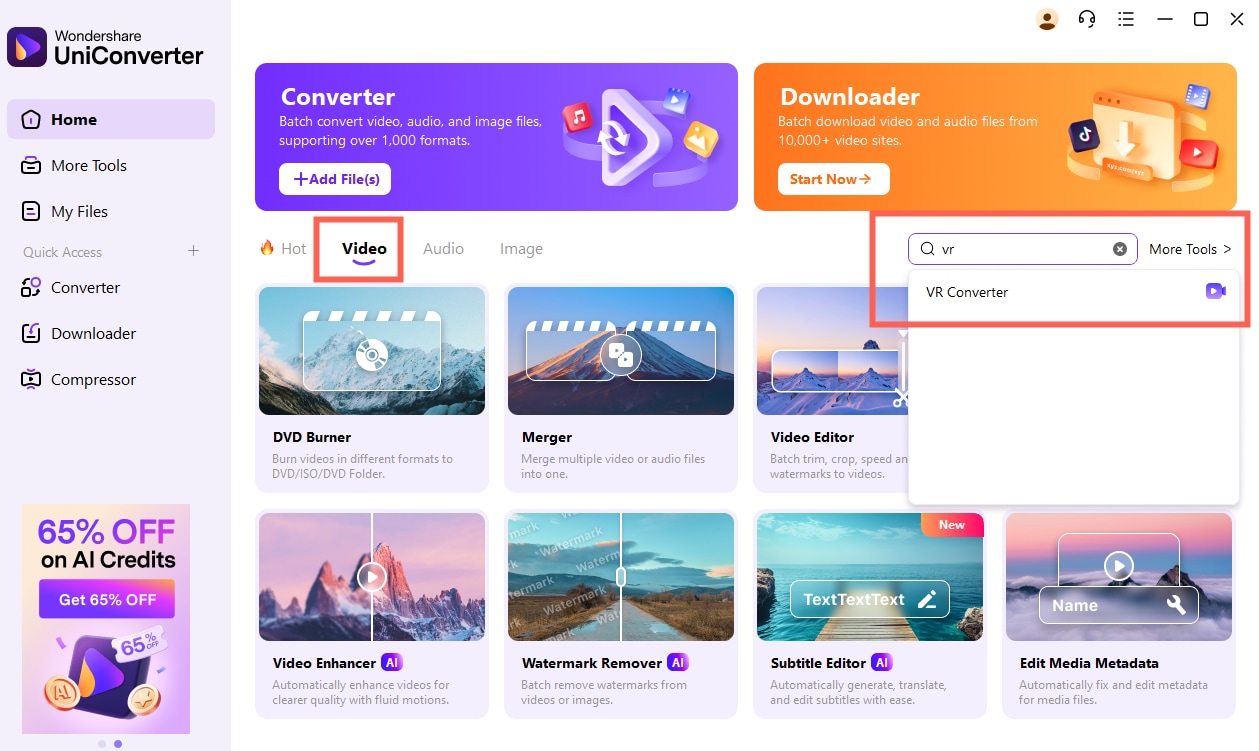
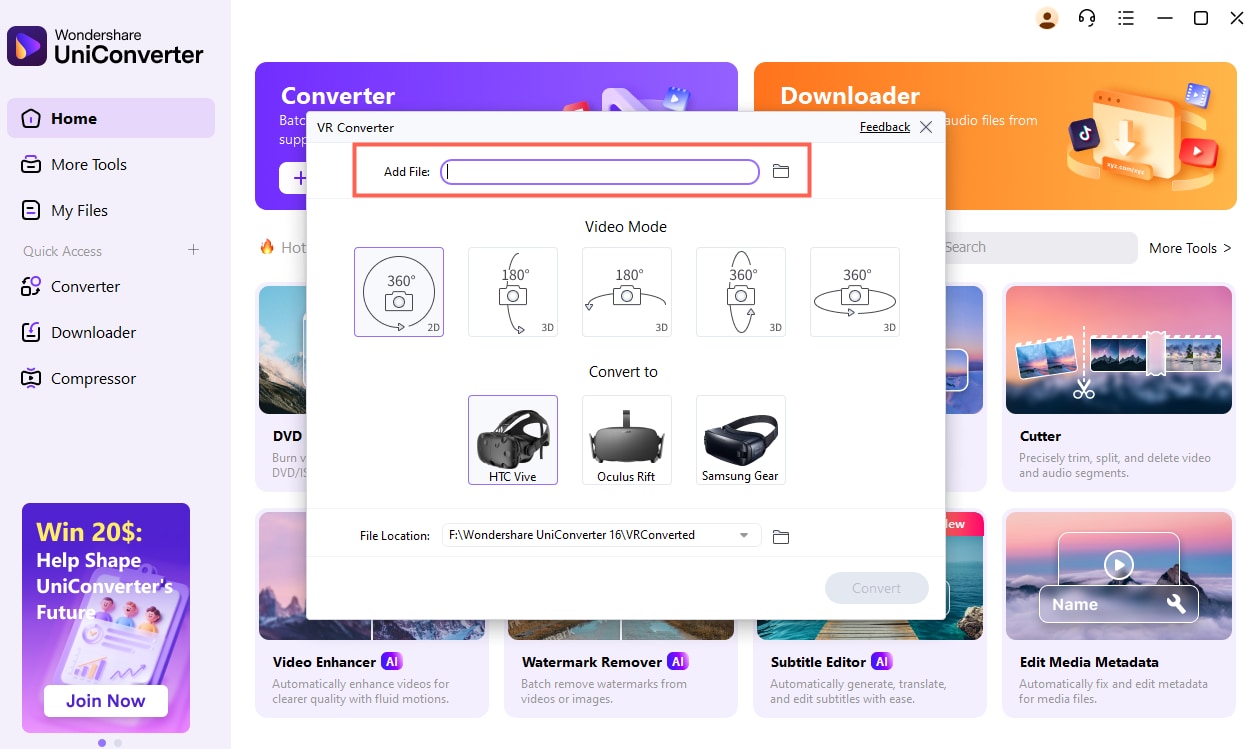
Step 1: Open the VR Converter in UniConverter.
Launch Wondershare UniConverter, go to the Video tab, and open the VR Converter tool.
Step 2: Import your video and choose VR output settings.
Add your MP4, MOV, AVI, or other supported video file. Then choose the available VR video mode and select the target VR device or playback preference based on your headset.
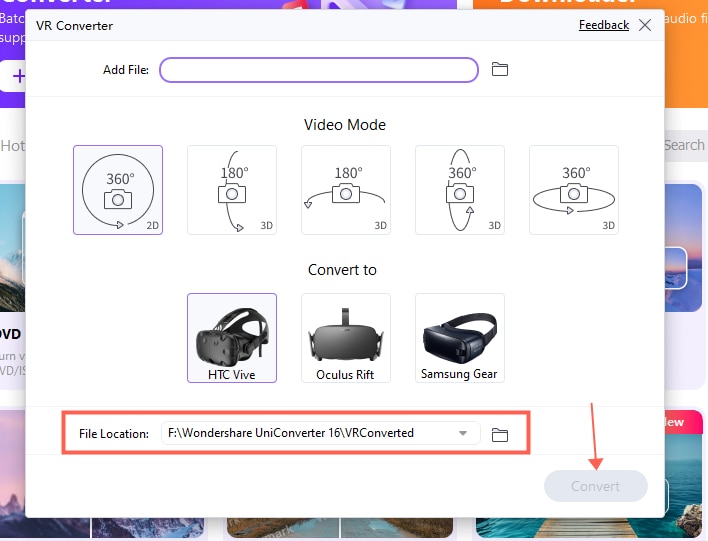
Step 3: Export and test the VR-ready video.
Choose an output folder, start the conversion, and test the exported file in your VR player or headset. If the video still looks flat, check whether the player supports the selected VR mode and whether the file needs proper VR metadata.
How to Convert Normal Video to VR Online
If you prefer not to install desktop software, you can try a browser-based video to VR converter online. Online tools are useful for quick tests or one-time conversions, but they may require an account, upload your video to a server, or include file size and pricing limits. BuildVR is one online option that focuses on converting normal video or MP4 into VR-style output for headset and web playback.
Because Buildvr works in a browser, it can be used without installing desktop software. This makes it suitable for quick tests, one-time projects, or users who want to compare online VR conversion before choosing a desktop workflow. However, online conversion may require uploading your video, so it is better for non-sensitive files and smaller projects.
Steps to convert video to 360 VR online:
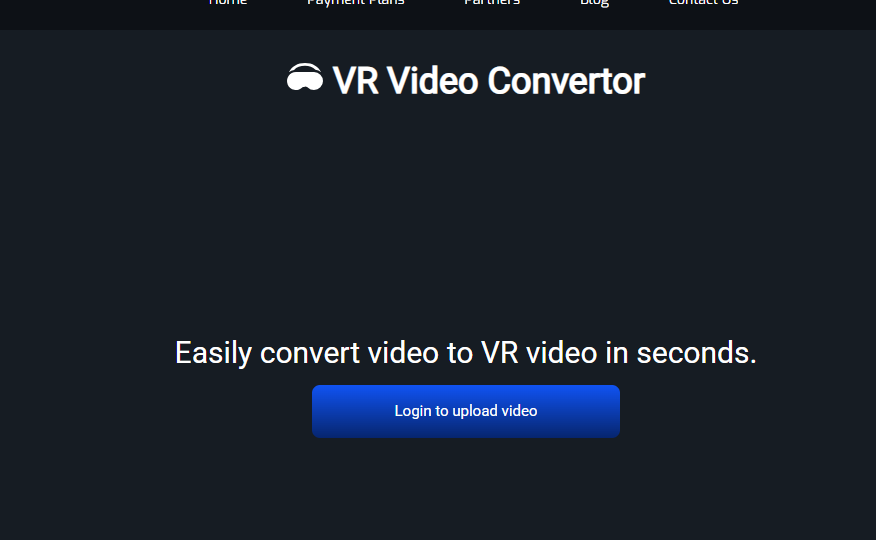
Step 1: Upload the source video.
Open the online VR video converter in your browser, sign in if required, and upload the normal video or MP4 file you want to convert.
Step 2: Choose the VR output preference.
Select the available VR output mode, video format, or sharing option based on how you want to watch or publish the final video.
Step 3: Convert and preview the result.
Start the conversion, then preview the output in a supported VR player or headset to check whether the video displays correctly.
Pros:
- It supports multiple formats for conversion.
- It works in a browser without installing desktop software.
- It can be useful for quick tests or one-time VR video conversion.
- The converted video may be easier to preview or share online, depending on the tool settings.
- The converted video is sharable with a link generated.
Cons:
- It is a paid tool.
FAQs about VR Video Converter
1. Can you convert a normal video to VR?
Yes, you can convert a normal (2D) video into a VR-compatible format, but it won’t become “true VR.” Instead, it will be displayed in a virtual theater mode or as a 360°-like experience by duplicating and reformatting the video for VR headsets. Some software tools like Wondershare UniConverter allow you to re-encode standard MP4 or AVI videos into side-by-side (SBS) or over-under (OU) formats, which VR players can recognize. However, this process does not add real 3D depth or 360° perspective — it mainly adapts the video for viewing inside a VR headset.
2. Can MP4 be VR?
Yes, an MP4 file can be used for VR, as long as the video itself is recorded or converted in a VR-compatible format (for example, 360°, 180°, side-by-side 3D, or over-under 3D). MP4 is simply a container format, so it can hold VR video just like it can hold standard 2D video. Whether an MP4 is “VR” depends on how it was encoded and whether VR metadata (projection and stereoscopic information) is included.
3. Is there a way to watch VR videos normally?
Yes, you can watch VR videos on a normal screen without a headset. They will usually appear as a flat equirectangular video, where the 360° view is stretched across the screen. Some video players (like VLC or YouTube) let you click and drag with your mouse to “look around” inside the VR video. While you won’t get the immersive 3D effect, you can still explore VR content in a normal 2D way.
4. What's the difference between 360 and VR180?
360 video captures a full sphere, letting viewers look in any direction—great for virtual tours, landscapes, and scene-setting stories. VR180 records only the front 180°, typically in stereoscopic 3D, so subjects feel more lifelike—ideal for vlogs, tutorials, and events focused in front of the camera.
- 360: full surroundings, maximum freedom of view.
- VR180: half sphere, stronger depth where it matters.
5. What is the difference between a VR video converter and a 360 video converter?
A VR video converter usually prepares a video for headset playback, such as side-by-side, over-under, or VR-style viewing. A 360 video converter focuses more on spherical 360° video playback, where viewers can look around the scene. Some tools support both workflows, but a converted normal video still cannot become true native 360° footage unless the full scene was originally captured.
6. Why doesn't 2D→VR look “truly 3D”?
A 2D source lacks binocular disparity—the two slightly different views our eyes need for real depth. Software or AI can estimate a depth map to simulate parallax, but it’s still an approximation, so converted footage feels immersive without matching native stereoscopic capture.
7. How do I convert MP4 to VR?
You can convert MP4 to a VR-compatible format by importing the MP4 file into a desktop VR video converter, choosing a supported VR mode or target headset, and exporting the result for VR playback. For quick tests, an online MP4 to VR converter may also work, but upload limits and account requirements may apply.
8. Can any video be turned into a 360 VR video?
Not fully. Any normal video can be adapted for VR-style viewing, but it cannot become true native 360° footage unless the full scene was originally captured with a 360 camera or created as a 360 environment. Conversion can change how the video is displayed, but it cannot recreate missing views behind or around the camera.
9. Why does my converted VR video still look flat?
A converted video may still look flat because the original file has only one camera view. Some tools can create a side-by-side or over-under format for headset playback, but real 3D depth requires separate left-eye and right-eye views or accurate depth information.
10. What is the best video format for VR playback?
MP4 is commonly used for VR playback because many headsets and players support it. The final result still depends on the video mode, codec, resolution, metadata, and the VR player you use.
11. Do I need special metadata for YouTube 360 video?
Yes. YouTube needs properly prepared 180° or 360° video files, and you should verify that 360° playback is enabled after upload. If the file is missing the right projection or stereo information, it may be treated as a normal flat video.
Conclusion
Converting normal video to VR is mainly about making a standard video easier to watch in a headset, not turning it into true native 360° footage. For desktop conversion and local MP4 files, Wondershare UniConverter gives you a practical VR converter workflow. If you need a stronger 2D-to-3D style effect, Ani3D can be introduced as a dedicated 3D video option. For quick browser-based tests, an online VR video converter can be useful, but always check upload limits, pricing, and playback compatibility before relying on the final file.
Convert Video to 360 Convert Video to 360

Your complete video toolbox

Other popular Articles From Wondershare
Kayla Morrison
staff Editor