How to Convert VIDEO to GIF Online

Add a local video
Click Add File or drag your video into the tool above. Choose a file you own or have permission to process. A short source clip reduces processing and makes it easier to create a focused animation.

Choose GIF output
Select GIF in the output controls. If you need exact start and end times, prepare the clip first or use Desktop GIF Maker. The image dimensions and frame rate should suit the destination instead of simply copying the largest source settings.

Convert, save and replay
Save the GIF and replay it in a browser. Check the transition from its last frame back to the first, confirm that small text is readable, and compare the actual saved size with the upload limit of your destination.
How to Convert Video to GIF on Desktop
In Desktop Converter, choose GIF under the Image output category. Review the available settings, choose Save to and run Convert All. For exact segment selection plus output size and frame-rate controls, use Tools > GIF Maker > Video to GIF instead.
Follow the official desktop workflow; the illustrations below show desktop controls rather than the online upload tool.
1. Import a prepared video
Open UniConverter Desktop and select Converter on the Home screen. Use Add Files to import a local video. If the recording is long, prepare the short segment you want before converting.
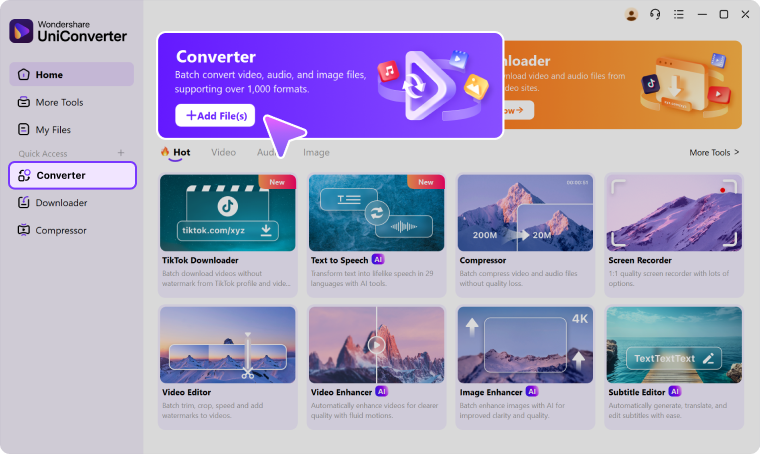
2. Choose Image > GIF
Open Convert to and select GIF under the Image output category. Review the available output settings. For exact segment selection and explicit frame-rate and output-size controls, use Tools > GIF Maker > Video to GIF instead.
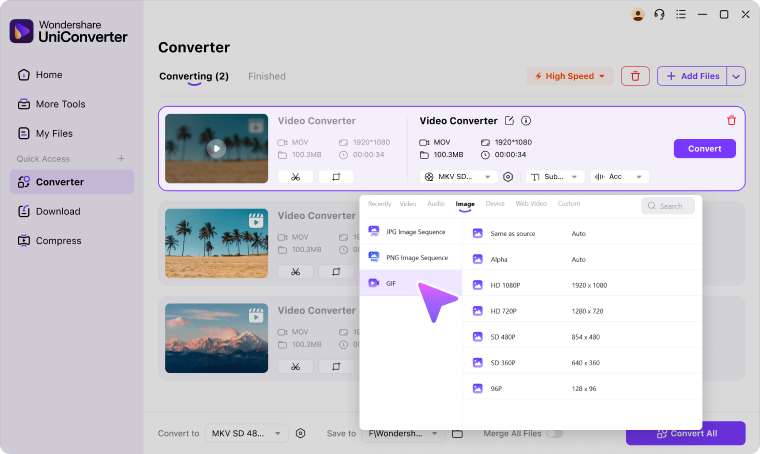
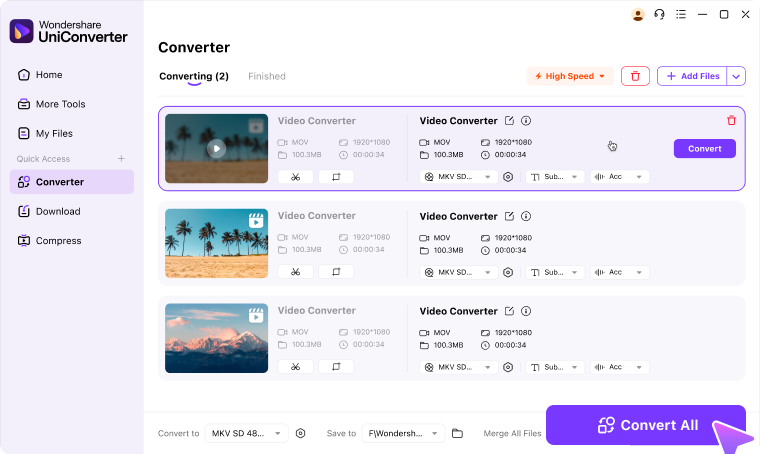
3. Convert and review the animation
Choose Save to and select Convert All. Open the Finished tab to locate the GIF, then replay it in a browser. Check the loop transition, readable details, pixel dimensions and actual file size. The GIF will not contain the source audio.
Before you finish: compare the result with the source, check the actual dimensions and file size, and open it in the application where it will be used. Keep the original until these checks pass.
Choose the Right Output for Your Clip
| What to compare | Source / need | Output / recommendation |
|---|---|---|
| Keep sound | Use MP4 or another suitable video output | GIF is silent |
| Show a short repeating action | Use animated GIF | Trim to one clear moment |
| Keep a long demonstration | Use video | A long GIF can become unnecessarily large |
| Show one frame | Use a JPG or PNG still | An image is different from a moving GIF |
| Preserve more color detail | Use a suitable video or modern animation format | GIF has palette limitations |
| Reduce an oversized GIF | Shorten, resize or reduce frame rate | Inspect the action after each adjustment |
| Convert on a computer | Use Desktop Converter or GIF Maker | Choose the workflow for whole-file conversion or segment selection |
| Reverse the direction | Use GIF to MP4 | This page owns video-to-GIF creation |
References: Workflow and format reference · Additional format guidance
Practical Tips for VIDEO to GIF
Start with the Action You Want to Show
A useful GIF shows one idea: a reaction, a button interaction or a short movement. Trim away the lead-in and pauses before fine-tuning compression. A few seconds is a useful starting point for many reactions, but the correct duration depends on the action. Keep enough context for someone seeing the loop for the first time.
Use a Converter or GIF Maker for Different Jobs
Desktop Converter changes a prepared video into GIF output and can manage a local queue. GIF Maker is useful when you want to select the exact start and end of one source clip and set output size and frame rate. Choose by the task rather than expecting every control to appear in both workflows or in the online widget.
Balance Frame Rate and File Size
More frames can improve motion but also increase the amount of image data. For a small reaction, about 10–15 fps is a practical starting suggestion. Fast movement or a cursor demonstration may need adjustment. Compare the actual exported animation instead of assuming that the highest frame rate always gives the best usable GIF.
Keep Text Readable at the Final Dimensions
Screen recordings often contain labels that become unreadable when resized. Crop or prepare the important region before conversion, then view the GIF at the size at which it will be shown. Increasing resolution after detail has been discarded does not restore the original text. Keep a video copy for demonstrations that need a larger view.
Review Silence, Color and Looping
GIF removes the soundtrack and may change color gradients because it uses a limited palette per frame. Choose visual content that remains understandable without sound. Replay the output to inspect the loop seam and motion. A browser preview is a better animation check than a static thumbnail in a file manager.
Convert Local Files with Desktop Controls
UniConverter Desktop offers an organized queue, output selection and a destination folder for regular conversion work. Use it when the source files are already on your computer or when you need repeatable settings. A free online allowance and the desktop trial are different forms of access; select the route that fits the actual workload.
video to GIF FAQs
How do I turn a video into a GIF?
Can I make a GIF from video for free online?
Which video formats can I turn into GIFs?
Does a GIF keep audio from a video?
How can I make a smaller GIF without ruining it?
What is a good frame rate for video-to-GIF conversion?
Why does my GIF look blurry, banded or static?
How do I convert a GIF into video instead?
What Customers Say About UniConverter
Related Conversion Tools and Guides



Turn Video into an Animated GIF